

What Documents Do I Need for a Rental Application? A 2026 Guide for Stress-Free Leasing

Introduction: Why Rental Application Documentation Matters in 2026

The Stakes for Renters and Owners
Applying for a rental property is more than just filling out a rental application. For property owners, proper documentation streamlines the tenant screening process and protects investments. Prospective tenants, on the other hand, need to present themselves as trustworthy and responsible. In 2026, with the growing sophistication of property managers and automated platforms, having the right rental application documents is essential to stand out from other applicants and avoid delays. Bringing all the required documentation prepares you for the competitive rental process, ensuring you can pay rent, provide necessary references, and comply fully with what property managers require prospective tenants to submit.
How Application Standards Have Changed
Rental application processes continue to evolve, reflecting a strong focus on financial stability, background checks, and digital security. Modern property managers require prospective tenants to provide comprehensive, up-to-date information—even more so since rising concerns about identity theft and application fraud have raised the bar for verification. The rental application process now frequently requires additional verification—such as detailed rental history from previous landlords, professional references, and even proof you pay bills on time. The application process has become more thorough and standardized than ever.
Trends: Digital Submissions & Fraud Prevention
Most landlords now use secure portals for application documents, emphasizing encryption and rapid verification. Applicants should expect multi-step consent forms for background checks and credit checks within the rental application process, and more emphasis on digital footprints and e-verification of employment or rental history. Most landlords even require digital uploads of government issued ID and proof of income to begin tenant screening efficiently.
The Standard Rental Application Checklist: Documents You’ll Always Need
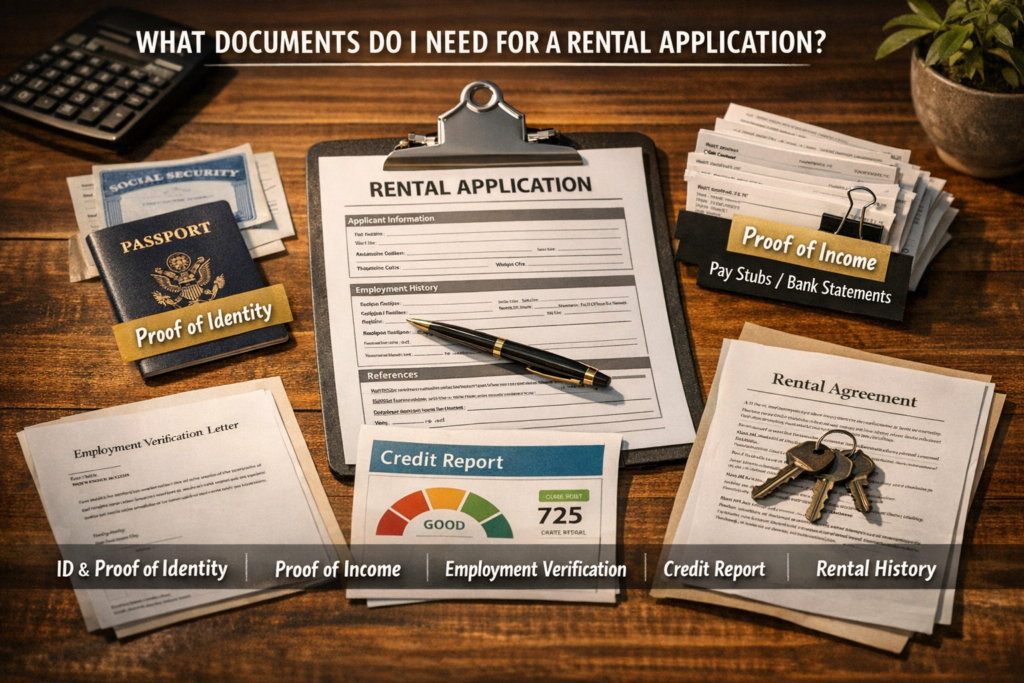
Successful renters prepare these key rental application documents in advance during the application process:
- Government issued ID, like a driver’s license or passport
- Proof of income—recent pay stubs, bank statements, or tax returns to verify you can pay rent
- Employment verification (HR letter, recent pay stubs, or manager contact info for income verification)
- Rental history and references (contact info for previous landlords, rental ledger, or lease agreement)
- Consent for a credit report and background check
The application fee, security deposit, and sometimes pet documentation or consent forms may also be required documentation. Proof that you make prompt rent payments is often required by property managers as part of routine tenant screening.
Proof of Identity
A government-issued ID—usually a driver’s license, state ID, or passport—is a universal requirement and a crucial piece of proper documentation, confirming your identity for the property owner, landlord or property managers. Most landlords insist on these rental documents for all potential tenants as part of their required documentation checklist.
Proof of Income
Most landlords require recent pay stubs or equivalent income verification to ensure you can reliably pay rent. If you’re self-employed, expect to provide bank statements, recent pay stubs, or recent tax returns showing consistent income and ability to handle monthly rent. Bank statements and tax returns provide stronger evidence for self employed applicants.
Proof of Employment
Employment verification as a required documentation could be a letter from your HR department, manager, or your most recent pay stubs. Most rental applications require at least contact information for employment verification, especially for responsible tenant status.
Rental History and References
Rental ledgers (showing your record of rent payments) and reference letters from past landlords or professional references establish your rental history—a key indicator to property owners that you’ll be a good tenant. Listing previous landlords and lease agreement details strengthens your case against other applicants.
Credit Report Permission
Most application processes will require explicit permission to pull a credit report or conduct a credit check as part of the tenant screening process for all potential tenants. A good credit score is a primary factor for acceptance. Don’t forget to sign all consent forms as part of your application process.
What If You’re Missing Something?
Missing rental application documents doesn’t have to mean instant rejection—communication is key. KT Rents recommends explaining any gaps up front and offering supplementary documentation or references where possible, whether you lack a driver’s license, have gaps in your rental history, or are missing a recent bank statement. Being open with property managers helps demonstrate you’re a responsible tenant.
Quick Tips: The same documents are used by most landlords nationwide: a government issued ID, proof of income (recent pay stubs or bank statements), rental history (lease agreement and prior landlord references), professional references, and signed authorization for a credit/background check. Having these prepared speeds the rental application process and helps you stand out from other prospective tenants.
Proof of Identity: Making Sure You’re You

Acceptable Documents (Driver’s License, Passport, State ID)
Acceptable rental application documents for identity include a valid driver’s license, state ID, military ID, or passport. These must be current, unexpired, and clearly show your picture and signature for identification during the rental process. Most landlords require digital copies uploaded through their rental application portal.
Special Considerations for International Applicants
International renters should provide a passport, current visa/residency documents, and, if possible, a translated utility bill or government correspondence to establish identity and address history. These rental documents support your rental application and help property managers verify your background.
What Counts as a Valid Government Issued ID?
Valid documents must be issued by a recognized government authority and be valid at the time of application. Digital scans or clear photographs are typically acceptable for digital rental application submissions as required documentation for all potential tenants.
Proof of Income: Showing You Can Afford the Rent
Pay Stubs and Offer Letters
Standard proof of income for your rental application includes your last 2–3 recent pay stubs. In some cases, a job offer letter can be accepted if you’re starting work soon. Pay stubs are a required documentation to show you can afford the monthly rent and consistently pay bills.
Bank Statements
Bank statements are sometimes requested alongside pay stubs to verify consistent deposits and ability to cover monthly rent payments. For self employed applicants, showing regular client payments on your bank statements and providing other income verification like tax returns can strengthen your rental application documents.
Tax Returns
Self-employed and freelance applicants should provide federal tax returns from the most recent year—especially Schedule C or 1099 forms—as proof of income. Some property managers request tax returns as part of their rental application process for anyone with nontraditional or variable income streams.
When and Why Additional Proof May Be Needed
Property managers may request extra proof of income or employment verification if income sources vary, if employment is recent, or if there are gaps in employment history. Always include a brief cover letter explaining your situation if your documentation is unconventional or incomplete.
Quick Tips: For most rental applications, income documentation should cover at least the past two months—or the latest tax year for nontraditional earners—to satisfy landlord requirements. Proof you can pay rent is essential, so prepare your pay stubs, bank statements, or tax returns in advance.
Employment Verification: Confirming Job Stability

HR Letters vs Manager Contacts
Employment verification usually comes in two forms: a formal letter from your company’s HR department or direct contact details for your immediate supervisor. Both should confirm your role, position, and tenure within the rental application. Many rental applications also require recent pay stubs for employment verification and monthly rent calculations.
Self-Employed, Freelance, and Gig Workers
Self employed applicants must furnish a mix of business bank statements, client contracts, and recent tax returns. If you’re a freelancer or gig worker, add payment platform screenshots and bank records as part of your application documents. Organizing all proper documentation reassures property owners and property managers of your ability to pay rent.
How to Present Nontraditional Income Streams
Present a cover sheet summarizing your average monthly earnings, payment sources, and income consistency. Clear income verification makes your rental application stronger, even if your income comes from multiple jobs, gigs, or freelance work. Attach required documentation—proof of recent payments, new contracts, and recent bank statements.
Rental History & References: Building Trust with Your Landlord
Rental Ledgers
A rental ledger, or record of past rent payments, proves your track record of timely rent. Many rental property owners see this as a signal of a responsible tenant with a history of reliable rent payments.
Reference Letters from Previous Landlords
Letters or emails from past landlords (or property managers) attesting to your reliability, cleanliness, and communication build trust for new property owners. It’s wise to prepare at least two references from previous landlords, as many property managers require prospective tenants to verify rental history using these rental documents.
Handling Gaps in Rental History
If your rental history is sparse, substitute professional references or supervisors who can vouch for your character and reliability. Include reference letters and contact information for each source. Communication about your circumstances often makes property managers more flexible with required documentation.
What If You’re a First-Time Renter?
First-time renters should use professional references from employers or instructors and provide a co-signer if possible. A qualified co signer with good credit can make your application more appealing when you lack rental history. Property managers may ask for additional proof of income or pay stubs from the co-signer as part of their tenant screening process.
Quick Tips: Most landlords and property managers want at least two references—preferably from previous landlords—to confirm you’re likely to be a good tenant. Digital ledgers and clear communication about any rental history gaps help you rise above other applicants. Attach professional references and lease agreements when possible.
Credit Screening: What to Expect and How to Prepare

Authorization Forms
You’ll be asked to sign consent forms, giving the property manager or property owner authorization to conduct a credit check and background check. These forms are required documentation before proceeding with your rental application. A thorough credit report is standard for nearly all property managers’ tenant screening processes.
What Landlords Look For
Landlords look for a good credit score, minimal outstanding debt, and a history of timely payments. They focus on patterns: Do you pay bills and rent on time? Do you have any recent bankruptcies, evictions, or skipped rent payments? A strong credit report is critical, but some property managers will also review additional application documents (like pay stubs or tax returns) to assess your reliability.
Improving Your Credit Picture
Pay down debts, check your credit report for accuracy before applying, and dispute errors prior to submitting your rental application. Keep records of settled accounts and proof of timely payments as supplementary documentation for your rental property application.
Internal link: Tips for Building Better Credit as a Renter
For help improving your renter profile and meeting good credit score criteria, check out our guide to renting vs. buying (and how to build better credit).
Supporting Documents: Going the Extra Mile
Pet Documentation
If you bring a pet, provide vet records, pet insurance, proof your animal complies with property rules, and, if needed, letters from previous landlords regarding pet behavior. Some rental applications request separate pet documentation and a pet deposit as part of required documentation for the rental process.
Co-Signer/Guarantor Forms
If your profile is borderline or you lack credit history, a co-signer or guarantor may be required. Collect their government issued ID, proof of income (like pay stubs or bank statements), credit report, and signed guarantor consent forms as part of the rental application documents package.
Miscellaneous (e.g., Student or Visa Status)
Students should provide enrollment verification, financial aid statements, and proof of sufficient funds to pay rent. International renters should add extra documentation about visa, residency, or financial sponsorship, plus translated bank statements and reference letters. These rental application documents help assure landlords they’ll receive reliable rent payments from all applicants.
Regional or Property-Specific Requests
Some rental properties—especially luxury or managed units—may ask for additional application documents or supporting forms, including tax returns, recent pay stubs, and professional references. Always ask for a property-specific checklist from your property managers at the outset of your rental process and clarify if income verification, consent forms, or employment letters must be notarized.
Quick Tips: Volunteering extra documentation—such as pet certifications or a cover letter—shows you’re proactive, organized, and serious about being a responsible tenant. The more thorough your documentation, the more confident landlords feel during tenant screening.
Digital Submission & Privacy: Protecting Your Sensitive Information

Best Practices for Secure Uploads
Always use secure, encrypted portals for uploading rental application documents. Avoid emailing sensitive files. Many property managers prefer secure uploads for all application documents, including pay stubs, bank statements, and government ID. This helps ensure your privacy throughout the application process.
How KT Rents Keeps Your Data Safe
We use encrypted platforms, watermark sensitive files, and never share your data beyond what’s required for the rental application process. For more details on our privacy practices for prospective tenants, review our privacy policy.
Knowing Your Rights (Fair Housing & Data Privacy)
Tenants are protected by federal and state laws. You cannot be screened differently due to race, nationality, or other protected characteristics during the tenant screening and rental process. For more on your rights and how your application fee and required documents are treated, see KT Rents’s Fair Housing resources.
Redacting and Watermarking Personal Documents
Before uploading, consider watermarking documents (like your driver’s license or tax returns) or redacting non-essential information to add an extra layer of protection. Protecting your rental application documents and understanding who can access them is key to a secure rental process.
Special Cases: What If Your Situation Doesn’t Fit the Mold?
Nontraditional Income (Freelance, Gig, International Wires)
Provide as much paper trail as possible—screenshots of major client payments, international wire receipts, or regular platform payout reports. Pair these with a short letter explaining your work structure and use tax returns or bank statements to back up your proof of income. This is especially helpful for self employed applicants or anyone with variable income.
Roommates & Multiple Applicants
Each applicant should submit the same documents for the rental application—ID, proof of income (pay stubs or bank statements), rental history, and references; landlords will screen every adult intending to live in the unit. Synchronize your submissions to keep the application process moving. Most property managers require prospective tenants to provide individual application documents and may request a co signer for anyone lacking a good credit score or rental history.
Recent Graduates and Students
Use student loan distribution documents, enrollment verification, and parental guarantees as proof of ability to pay rent for your rental application. Consider submitting a co-signer application along with your own documents and include proof of income (such as recent pay stubs from a part-time job) if available.
Communicating Unique Circumstances Effectively
Always be transparent about unusual situations in your application documents—communication builds trust and helps property managers find solutions on your behalf. Provide supplementary information if you’re missing a lease agreement, have no previous landlords, or have gaps in your rental history. Being thorough and honest can help offset a lack of traditional rental application documents.
Quick Tips: For gig economy workers or students, organizing diverse sources of proof of income, government issued ID, and clear reference letters can offset a lack of rental history or traditional employment on your rental application. Landlords respond well to detailed, clear documentation—even if your work or income is nontraditional.
KT Rents’s Pro Tips: Fast-Track Your Application Approval

Techniques for a Complete, Compelling Submission
Prepare digital files ahead of time and ensure all application documents are clear and legible. Group all documents (ID, income, lease agreement, rental history, references, consent forms, pet documentation, etc.) for faster review. Add a short cover letter explaining anything confusing or nontraditional in your application for maximum transparency during tenant screening.
Common Mistakes to Avoid
- Submitting old or expired documents (make sure driver’s license, pay stubs, and bank statements are current!)
- Forgetting to sign authorization or consent forms for your background check and credit report
- Poorly scanned or incomplete paperwork, missing pages, or omitted rental history
- Not paying the application fee in full or on time
How Our Team Supports You Each Step
KT Rents’s experienced property managers walk you through each step, provide checklists, and offer direct feedback so your application never gets overlooked. Explore available rentals now in our homes for rent portal or calculate affordability with our rent calculator.
Internal link: How to Reduce Vacancy with KT Rents Property Management
Learn how our property management services help landlords reduce vacancy and find the most reliable, responsible tenants in our rental property investments section.
Conclusion: Applying with Confidence in 2026
Why Preparation Pays Off
The rental application process doesn’t have to be stressful. By organizing required documentation—government issued ID (driver’s license or passport), proof of income (pay stubs, bank statements, tax returns), rental documents (rental history, lease agreement), and professional references or application fee— you project the qualities of a good tenant and make a strong first impression. Submitting all application documents requested by most landlords in advance fast-tracks your rental process and improves approval odds.
KT Rents—Your Partner for Hassle-Free Leasing
At KT Rents, we’re here to simplify the rental process for both renters and property owners. From application to lease agreement, our support ensures a smooth transition into your new home or rental property, guiding you step-by-step through application documents, security deposit requirements, and rent payments.