

Enterprise, Nevada
Homes for rent and for sale — search the map or open the full city SEO catch-all page.
Enterprise, Nevada
Moving to Enterprise, Nevada means settling into a large unincorporated Clark County community southwest of Las Vegas, with a population of roughly 250,000, median household income of $98,462, and median rent of $1,934 per month. No individual state income tax applies, but summer cooling costs, car dependence, and significant variation by address are real factors. Verify schools, commute times, and HOA rules by specific address before committing.
Moving to Enterprise, Nevada
Enterprise is a large unincorporated town in Clark County, Nevada, sitting southwest of the Las Vegas Strip, with newer housing, several master-planned communities, and full access to the Las Vegas Valley job and entertainment market. But at roughly 67 square miles, rent, school assignment, commute times, and amenities change block by block. Compare exact addresses, not “Enterprise” as a whole.
This guide is for renters, remote workers, relocating households, and owners weighing a move. Moving to Enterprise, Nevada works best when you treat the area as a set of corridors rather than one place, so our focus here is on what changes from address to address. Two ideas run through all of it. First, “unincorporated town” means Clark County governs the area and your mail may still read Las Vegas, NV. Second, “address-first” means two homes three miles apart can differ in rent, zoned school, HOA rules, and drive time. Last updated October 2026.
Where Is Enterprise, NV, and Is It Part of Las Vegas?
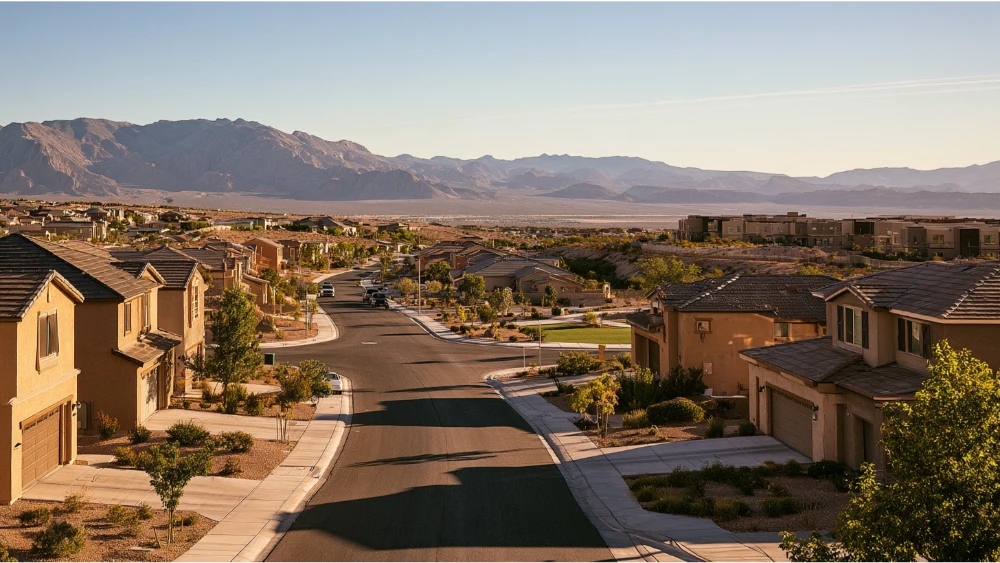
Enterprise is not an incorporated city. There’s no mayor and no city council. Clark County handles planning, parks, code enforcement, and permits, while the Enterprise Town Advisory Board gathers resident input and makes recommendations to the county. That’s an important distinction when you’re trying to figure out who to call about a zoning question or a park project.
Clark County lists the Enterprise planning area at roughly 42,950 acres, or about 67 square miles. That’s bigger than many mid-sized American cities, and it stretches from the Beltway down toward the southern edge of the valley. It covers a lot of ground.
Here’s the quirk that trips up almost every newcomer: your listing, your driver’s license, and your Amazon packages may all say “Las Vegas, NV” with a 89113, 89123, 89141, 89148, or 89178 ZIP code while the property sits squarely inside Enterprise. The city line on a listing page is not a reliable guide to your school, your HOA, or your service providers. Verify by address with Clark County before you get attached to a property.
Enterprise at a Glance: What the Local Market Data Actually Says
Enterprise grew about 104.5% between 2010 and 2020, which explains why so much of the housing stock is newer construction compared with older parts of the valley.
| Fact | Number | Source and date |
|---|---|---|
| Population | 108,481 | U.S. Census, 2010 |
| Population | 221,831 | U.S. Census, 2020 |
| Population estimate | ~250,461 | ACS one-year estimate, 2024 |
| Land area | ~66 to 67 sq. mi. | Census 2020 / Clark County |
| Population density | ~3,361 per sq. mi. | U.S. Census, 2020 |
| Median household income | $98,462 | ACS 5-year 2020 to 2024, in 2024 dollars |
| Median gross rent | $1,934/month | ACS 5-year 2020 to 2024 |
| Median owner-occupied home value | $475,500 | ACS 5-year 2020 to 2024 |
| Owner-occupied housing rate | 63.7% | ACS 5-year 2020 to 2024 |
| Mean commute | 23.8 minutes | ACS 5-year 2020 to 2024 |
| Broadband subscription | 96.9% | ACS 5-year 2020 to 2024 |
About 24% of Enterprise residents are foreign-born, and roughly 32.3% of residents age five and older speak a language other than English at home. If English isn’t your first language and you’d rather handle a rental conversation in Spanish, we can do that. Se Habla Español.
What Does It Cost to Live in Enterprise, NV?
Rent and housing costs
The Census Bureau puts median gross rent in Enterprise at $1,934 per month (2020 to 2024 five-year estimates). Median owner-occupied home value is $475,500, with a median monthly owner cost of $2,106 for households carrying a mortgage.
For a second reference point, here are HUD’s FY 2026 Fair Market Rents for the Las Vegas, Henderson, North Las Vegas metro. These are metro-wide program benchmarks used for housing assistance, not Enterprise asking rents and not a guarantee of what you’ll pay:
| Unit size | FY 2026 HUD FMR |
|---|---|
| Studio | $1,333 |
| 1 bedroom | $1,478 |
| 2 bedrooms | $1,735 |
| 3 bedrooms | $2,413 |
| 4 bedrooms | $2,764 |
The costs people forget
- Summer electricity, which can be the single biggest swing in your monthly budget from June through September
- Renter’s insurance
- Pet rent, pet deposits, and breed or weight limits
- Covered parking, which is sometimes an extra charge at apartment communities
- HOA-related charges or amenity fees passed along in a lease
- Internet and utility providers, which vary by corridor
- Commuting fuel, especially if you’re driving across the valley daily
Advertised rent is the headline. Total monthly cost is the number that decides whether you’re comfortable. A lease that looks like a deal on paper can stop looking like one in August. Nevada has no individual state income tax, and property tax rates run comparatively low, but Clark County sales tax is 8.375%, so day-to-day purchases cost a bit more than the sticker suggests.
Before you shortlist a single property, run the math with our Rent Calculator and Cost of Living Calculator. Five minutes there will save you a lease you regret.
Enterprise Neighborhoods and Master-Planned Communities
We’re not going to rank these. Here’s what Clark County’s planning records actually say, so you can compare them on housing type, scale, and amenities.
- Mountain’s Edge. A master-planned community of roughly 2,500 acres, including about 2,150 residential acres plus commercial, office, and public facility land. Mountain’s Edge Regional Park offers sports fields, playgrounds, basketball and soccer facilities, walking paths, and picnic areas.
- Southern Highlands. About 2,299 acres in the southern valley, with single-family and medium-density residential land, commercial areas, a golf course, and neighborhood parks. The original development agreement capped residential development at 8,500 units. Some of the county’s plan details are historical, so treat them as background rather than current construction status.
- Rhodes Ranch. Roughly 1,451 acres, predominantly residential with mixed-use and commercial land. The development agreement caps most residential development at 12,621 units, excluding 1,000 units tied to a separate hotel and casino site.
- Silverado Ranch. A commonly used subarea name in southern Enterprise. The Silverado Ranch Community Center runs indoor recreation, classes, youth and teen programs, senior programming, and day camps.
People also talk about west, central, and south or southeast Enterprise as practical corridors. Be aware that listing sites, realtors, HOAs, developers, and county planning maps often use different names for the same ground, so a neighborhood label alone tells you very little. Hard numbers on acreage, unit caps, and amenities are more useful than a name.
The real tradeoff is apartment versus single-family rental, and new build versus established property. Newer construction usually means better insulation and a more efficient AC system. Established properties often mean mature shade trees and more square footage per dollar. And HOA rules on parking, pets, exterior changes, and landscaping vary by community. Read them before you sign, not after. Well-priced homes in the newer corridors can go quickly, so have your documents ready.
Jobs and the Local Market: Where Enterprise Residents Work
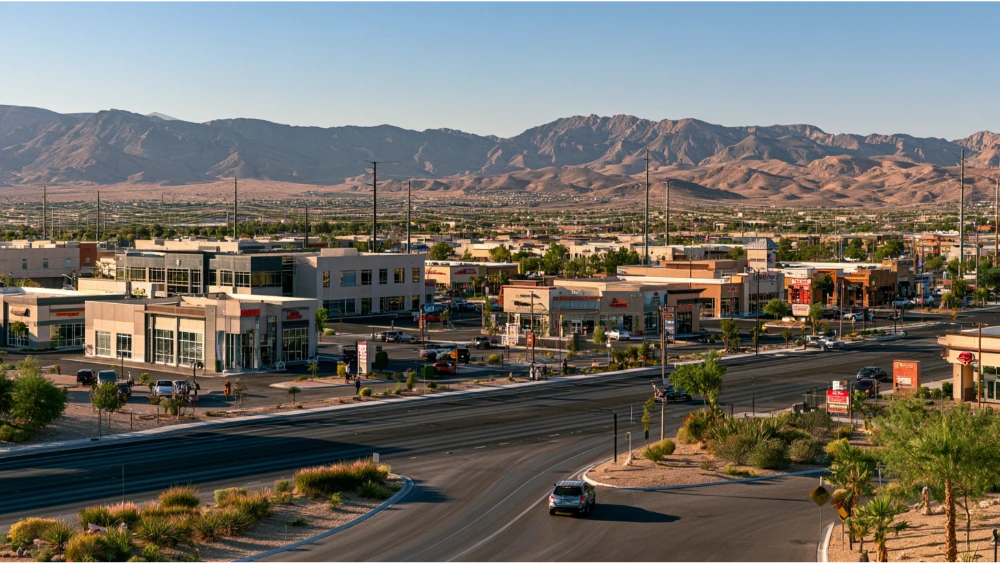
BLS doesn’t publish monthly employment data for Enterprise specifically, so the figures below are for the Las Vegas, Henderson, North Las Vegas metro area.
Metro unemployment was a preliminary 4.8% in August 2026 (not seasonally adjusted), down from 5.7% a year earlier. Metro nonfarm payrolls totaled roughly 1.1846 million jobs in August 2026, up 17,100 jobs or 1.5% year over year. July 2026 sector totals:
- Leisure and hospitality: 302,200
- Trade, transportation, and utilities: 210,800
- Professional and business services: 181,500
- Education and health services: 141,400
- Government: 113,700
- Construction: 81,900
Between July 2025 and July 2026, professional and business services grew 5.7% and education and health services grew 5.4%, while leisure and hospitality slipped 0.6%. Hospitality is still the biggest employer by a wide margin, but it’s no longer the only story. Clark County’s average weekly wage was $1,345 in Q1 2026, compared with $1,654 nationally. If you work a night shift in hospitality or healthcare, factor that into how you judge a commute and a street.
For remote professionals, that 96.9% broadband subscription rate matters more than any sector chart. Work-life geography is a choice, and Enterprise is a workable base for people whose paycheck doesn’t depend on the local economy at all.
Commuting and Easy Access: Getting Around Enterprise and the Las Vegas Valley
Enterprise residents reported a mean commute of 23.8 minutes in the 2020 to 2024 five-year estimates. The 2024 one-year estimate lands closer to 26 minutes. Neither is wrong. Five-year data smooths across a longer window, one-year data is more current but has a wider margin of error. Expect something in that range and verify for your own route.
Main corridors include Interstate 15, the Las Vegas Beltway (I-215 and CC-215), Blue Diamond Road, Warm Springs Road, Rainbow Boulevard, Durango Drive, and Southern Highlands Parkway. Enterprise is largely car-dependent, and transit convenience is not uniform across 67 square miles. Research the exact address rather than assuming.
Test your commute before you sign:
- Map the route at your actual work hours, not at 11 a.m. on a Tuesday.
- Check a backup route to I-15 or the Beltway in case your primary one closes.
- Look up transit stops near the specific address.
- Drive the grocery, school, and healthcare routes separately.
- Visit once on a weekday at rush hour and once on a weekend.
Schools, Hospitals, and Everyday Services
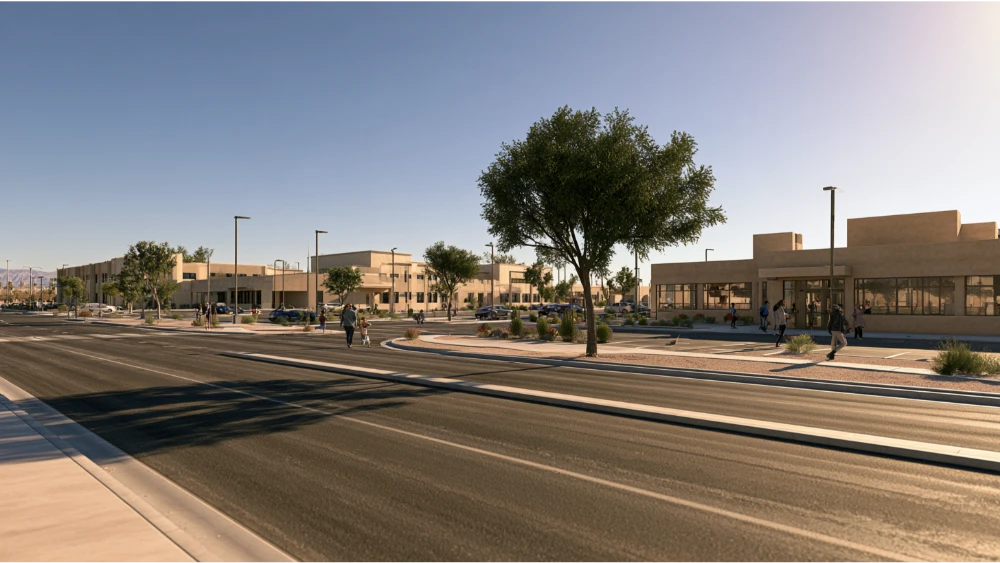
Schools
Clark County School District serves Enterprise, but assignment is address-specific and boundaries change. Use CCSD’s SchoolFinder for each property you’re considering rather than trusting a listing’s school claim. For ratings, proficiency, graduation, attendance, and staffing data, the Nevada Accountability Portal is the authoritative source, and it was updated with 2025 to 2026 school performance information in September 2026.
Beyond zoned schools, CCSD offers open enrollment, magnet, and career and technical programs. Southwest Career and Technical Academy is a full magnet high school serving grades 9 through 12, with programs ranging from nursing and dental assisting to automotive and diesel technology, culinary arts, digital game technology, and video production. Admission is application-based, not zoned. If you’re interested in one of these programs, pull the data, compare enrollment requirements, and judge for yourself.
Hospitals and healthcare
Know the difference between a full-service hospital, a neighborhood hospital, a freestanding emergency room, and an urgent care. They don’t offer the same services or carry the same costs. Facilities serving the southwest valley include St. Rose Dominican, San Martín Campus (8280 W. Warm Springs Road), Southern Hills Hospital and Medical Center (9300 W. Sunset Road), and the Blue Diamond neighborhood hospital (4855 Blue Diamond Road). The Southern Nevada Health District identifies regional trauma centers including UMC, Sunrise, and the St. Rose Siena Campus. Verify your insurance network and the actual drive time from your specific address.
Things to Do in Enterprise: Parks, Entertainment, and Easy Access to Las Vegas
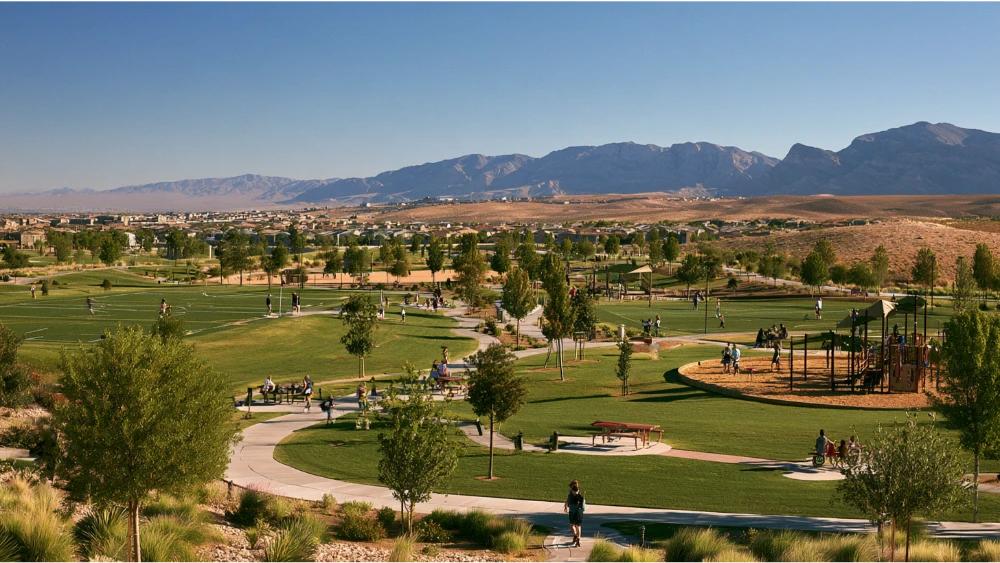
Living in Enterprise is not the same as living on the tourist corridor. Most of daily life happens well away from it, and there’s plenty to explore close to home.
- Parks and playgrounds: Mountain’s Edge Regional Park has sports fields, playgrounds, basketball and soccer facilities, walking and running paths, and picnic areas.
- Community programs: Silverado Ranch Community Center runs classes, youth and teen programming, senior activities, volleyball, day camps, and facility rentals.
- Neighborhood and linear parks: Built into planned communities like Southern Highlands and Mountain’s Edge, often connected by walking paths.
- Shopping, dining, cinemas, and fitness: Concentrated along the Blue Diamond, Rainbow, Durango, Warm Springs, and Las Vegas Boulevard corridors, which are the retail heart of daily life here.
- Live entertainment and sports: The wider valley brings concerts, professional sports, touring shows, and conventions within a reasonable drive.
- Day trips: Desert recreation and scenic drives are close enough for a morning out.
- Indoor options: Worth mapping before July and August arrive.
Weather, Water Rules, and What to Inspect Before You Rent
NOAA’s 1991 to 2020 normals for the Las Vegas airport station: January averages 58.5°F high and 40.5°F low. July averages 104.5°F and 82.0°F. August averages 102.8°F and 80.6°F. A normal year brings 78.2 days at or above 100°F and 137.2 days at or above 90°F.
That translates directly into daily life. Cooling costs spike in summer. Western sun exposure makes a measurable difference in comfort and in your power bill. Covered parking stops being a luxury around June. Outdoor exercise shifts to early morning. Never leave pets, children, medications, or electronics in a parked car. Monsoon season brings lightning, high wind, and sudden flash flooding near washes and low crossings, which is exactly why renter’s insurance exists and why filing a claim promptly after fire or flood damage matters.
On water: Southern Nevada assigns seasonal outdoor watering groups by address. As of October 2026, fall rules allow lawn watering on three assigned days per week through October 31, with no Sunday watering at any time of year. Schedules change by season, so look up your group through the SNWA address tool rather than relying on a number you read once. Knowing your assigned days keeps you clear of a violation notice.
Before you sign a lease, ask about AC age and who replaces filters, window exposure and the view from the main living space, shade and covered parking, whether there’s in-unit laundry or a shared laundry room, the pet policy, landscaping and HOA responsibilities, and exactly how maintenance requests get submitted and tracked.
Renting vs. Buying in Enterprise, and Your New Resident Checklist
Should you rent or buy?
Renting makes sense if you’re new to the valley, testing a commute, on a short assignment, or you want flexibility while you learn which corridor actually fits your life. Buying makes sense once you’ve confirmed the corridor, lived the commute, and verified the school assignment, and you plan to stay. With median home value at $475,500 (2020 to 2024 ACS) and prices varying substantially by neighborhood, the gap between a good decision and an expensive one is usually just a few months of real-world experience.
Run both sides through our Rent vs. Buy Calculator and Mortgage Calculator before you commit either way.
Your first 30 days in Nevada
- Transfer your driver’s license and vehicle registration within 30 days of establishing residency (Nevada DMV).
- Carry vehicle liability insurance from a Nevada-licensed carrier before driving on public roads.
- Gather two documents showing a Nevada residential address: lease, utility bill, bank statement, or pay stub.
- Check Nevada’s expanded online first-time registration tools, available to eligible new residents since April 2026.
- Set up power, water, internet, and trash service.
- Update voter registration and your mailing address.
- Look up your assigned watering group.
- Confirm your school assignment through CCSD SchoolFinder.
- If a roommate, partner, or brother is splitting the rent with you, get every adult named on the lease before move-in day.
Frequently Asked Questions
Is Enterprise, Nevada a good place to live?
It fits people who want newer housing, planned-community parks and amenities, no individual state income tax, and quick access to valley jobs and entertainment. The tradeoffs are severe summer heat, car dependence, and significant variation by address. Compare specific properties, not the town as a whole.
What is the cost of living in Enterprise, NV?
Median gross rent is $1,934 per month and median household income is $98,462 (2020 to 2024 ACS five-year estimates). Routine expenses can run slightly above the national average, and Clark County sales tax is 8.375%. Nevada charges no individual state income tax. Run your own numbers with our Cost of Living Calculator.
What is the crime rate in Enterprise, Nevada?
Conditions vary across a 67-square-mile area, so a single score is close to meaningless. Some third-party sources estimate crime roughly 27% below the Las Vegas average, but methodologies differ and we haven’t independently verified them. Check current address-level public safety data, then view the property in person during the day and again at night, and look at lighting, parking, and property condition.
Why are people moving out of Nevada?
Summer heat, rising housing costs, water-supply headlines, and job changes push some households out. At the same time, no individual state income tax and steady metro job growth keep pulling people in. Both things are true, and which one applies to you depends on your work and your budget.
Find Your Next Home in the Las Vegas Valley with KT Rents
We’re a full-service, broker-owned property management company and national rental marketplace operating across the U.S. since 2009. That’s 16+ years, 683 units across 34 states, and $187M under management as of early 2025. We hear from relocating households every week, and we understand that a new home has to feel like one, not just function like one. For renters, that means short-term and long-term leasing, pet-friendly filters, online applications and rent payment, maintenance requests handled through the portal, and perks after move-in like housewarming gifts and discounts on home goods, appliances, and insurance. That feeling of being settled is the point. Your Rental. Your Way.
Start with the Rent, Rent vs. Buy, Mortgage, and Cost of Living Calculators on our website, then spend some time browsing rental properties and checking availability. Call (800) 716-4950, text (608) 207-0657, or email info@ktrents.com. We respond within 24 hours. Se Habla Español.
Own a rental in the valley? Our team handles tenant placement, tenant screening, rent collection, property inspections, maintenance, rental permits, 1099s, and court evictions without you lifting a finger, for the equivalent of a cup of coffee and a donut per day. KT Rents reports a 98% occupancy rate, and we’re committed to keeping units filled rather than counting doors. You can post a property on our free listing platform, and we’ll keep making your cash flow the priority. Call (800) 716-4950 to get started with peace of mind.