

Kearney, Nebraska
Homes for rent and for sale — search the map or open the full city SEO catch-all page.
Kearney, Nebraska
Moving to Kearney, Nebraska means settling into a city of about 34,782 people with a median gross rent of $949, a 13.9-minute average commute, and two regional hospitals anchoring a stable local economy. Housing costs run below national averages, and UNK adds consistent university activity. Renting first is a smart move that lets you test a neighborhood through one full Nebraska winter before buying.
Moving to Kearney, Nebraska
Kearney is a growing small city in central Nebraska that works well if you want a short commute, two regional hospitals, university culture, and housing costs below major-metro levels. The tradeoffs are real: you’ll need a car, and you’ll live through four genuine seasons. The Census Bureau estimated the population at 34,782 as of July 1, 2025, and the mean commute at 13.9 minutes (2020–2024 ACS). Every housing number below is a dated Census survey estimate, not a live asking price. We wrote this for job relocations, UNK families, health care and education workers, and anyone relocating who is weighing whether to rent first.
Kearney, Nebraska at a Glance
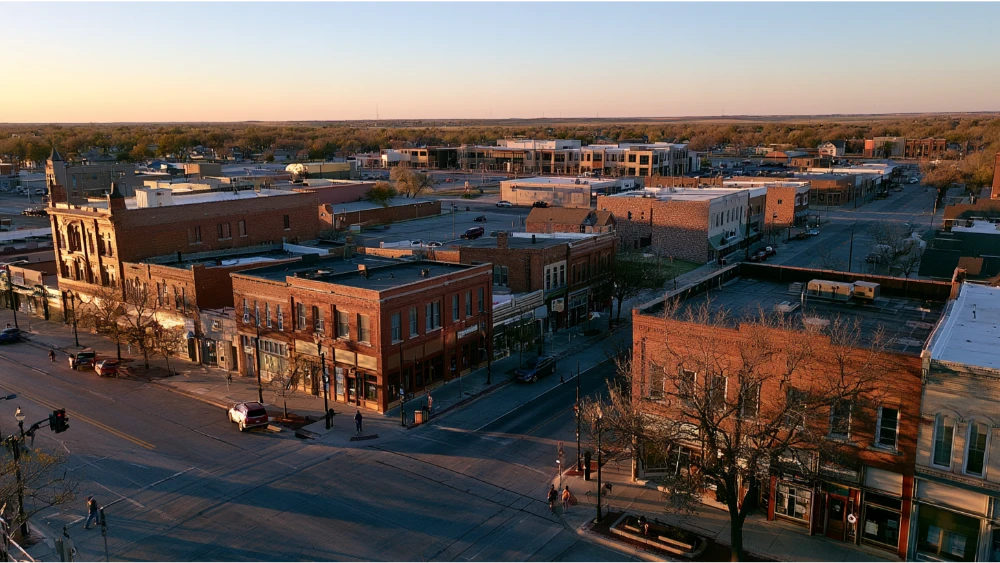
Kearney is located along Interstate 80, roughly midway between the Omaha–Lincoln corridor and the western end of the state.
| Measure | Figure (source, date) |
|---|---|
| Population | 34,782 (Census estimate, July 2025) |
| Households | 14,028 (2020–2024 ACS) |
| Median household income | $69,724 (2020–2024 ACS, 2024 dollars) |
| Median gross rent | $949 (2020–2024 ACS survey measure, not asking rent) |
| Median home value | $244,600 (2020–2024 ACS, not a sale price) |
| Mean commute | 13.9 minutes (2020–2024 ACS) |
| Public school enrollment | 6,058 (2025–26, Nebraska Dept. of Education) |
| UNK enrollment | 5,699 (fall 2025 census) |
| Combined sales tax | 7.0% (effective July 1, 2026) |
| January normal high / low | 35.9°F / 13.8°F (NOAA 1991–2020) |
| July normal high / low | 86.6°F / 63.0°F (NOAA 1991–2020) |
| Annual snowfall | 21.8 in. (NOAA 1991–2020) |
What Does Living in Kearney Cost?
Cost of living generally runs below the national average, with housing doing most of that work. The $949 median gross rent reflects what existing residents reported across 2020–2024. What you’ll pay on a unit leased today depends on size, condition, lease length, pets, included utilities, and how close you are to campus or work. Same caution applies to the $244,600 median value versus current sale prices.
Budget for water, sewer, and sanitation through the City of Kearney, plus electricity, gas, and internet (91.4% of households reported broadband in the 2020–2024 ACS, but verify service at your exact address). Ask who handles snow removal, lawn care, and parking.
Nebraska renter rules, as general information and not legal advice: security deposits are generally capped at one month’s rent, an additional pet deposit may run up to one-fourth of one month’s rent where applicable, and the balance plus a written itemization is generally due within 14 days after the tenancy ends. Before making a decision, run your numbers through our Cost of Living Calculator and Rent Calculator.
Jobs and the Local Economy in Central Nebraska
The durable sectors are health care, education (Kearney Public Schools and UNK), manufacturing, construction and skilled trades, public services, agriculture and food distribution, aviation, transportation, and retail and hospitality. Labor force participation was 71.1% (2020–2024 ACS), and Nebraska’s preliminary statewide unemployment rate was 2.9% in August 2026. That’s a state figure, not Kearney’s.
Be realistic. A Nebraska WARN filing announced 219 affected workers at a Kearney manufacturing site in July 2025, so secure the offer before the move. In a 2022–2023 area labor availability survey, 46.6% of Kearney-area respondents with a child under six named child care availability as an employment obstacle. Start waiting-list calls early. The daily payoff is that 14-minute average commute, which hands you back hours every week.
Schools, UNK, Hospitals, and Family Life

Kearney Public Schools
6,058 students (2025–26, NDE) across 14 schools per the NCES directory, including Kearney High School, Horizon and Sunrise middle schools, ten elementary campuses, and the Hanny Arram Center for Success. Student-teacher ratio was about 15.5 to 1 (2024–25, NCES), with AP and career and technical pathways. Important for any family making a plan around schools: the district states some grade levels and neighborhood schools may be full, that renting or buying in a zone does not guarantee placement at that school, that option enrollment and voluntary transfers may be limited, and that proof of residency is required. Confirm capacity before you choose an address.
UNK
5,699 students at the fall 2025 census, with 824 first-time full-time freshmen in fall 2026 (up 3.6%) even as overall enrollment declined. The university shapes the rental calendar, traffic near campus, part-time work, and the city’s median age of about 32.8 (2024 ACS five-year).
Health care
Two general hospitals: CHI Health Good Samaritan, a regional referral center with Level II trauma, advanced Level II NICU, primary stroke care, inpatient rehab, and hospital-based EMS and medical helicopter service; and Kearney Regional Medical Center, a 93-bed acute care hospital. A dedicated cancer center opened in 2024, so residents travel less for treatment than they did a few years ago. Official sources conflict on Good Samaritan’s bed count, so we’re not citing one.
Choosing an Area and Getting Around Kearney
Compare areas by geography and amenities. Downtown and the Bricks District offer the historic core, shops, culture, and denser or upper-floor units. The UNK and University Village area gives campus access and mixed-use development. North and northwest growth areas carry newer construction and major retail access. South and outer-edge options mean more land, longer drives, and different utility arrangements. Park- and trail-adjacent areas sit near Harmon, Yanney, Cottonmill, and Patriot.
I-80, U.S. 30, and several state highways serve the city. Kearney Regional Airport currently advertises daily nonstop service to Denver and Chicago O’Hare, though routes change, so verify before booking. RYDE provides demand-responsive transportation rather than a citywide fixed-route system, so plan on reliable vehicle access. Winter brings black ice and blowing snow. For safety research, use the City’s Police-to-Citizen resource and look at specific addresses rather than citywide labels.
Things to Do: Parks, Restaurants, and Everyday Living
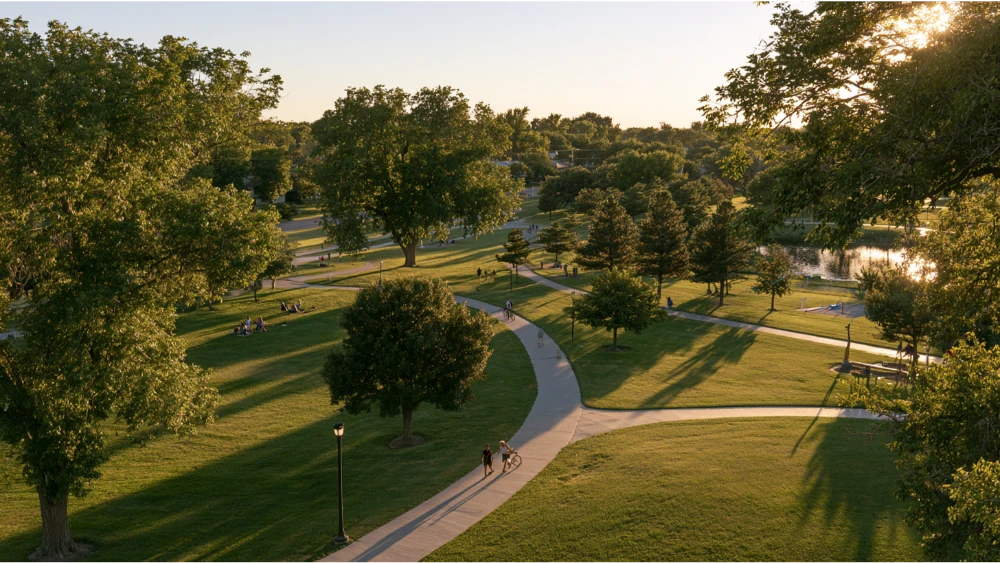
The city’s parks page lists 20 parks totaling nearly 720 acres, while an older recreation page says 18 parks and 600-plus acres, so verify the current count. Either way, you get more than 25 miles of community trails plus a 2.3-mile water trail connecting parks, schools, neighborhoods, and retail. Kayaking, golf, and fishing fill the warm months. Downtown’s Bricks District holds shops, restaurants, and live performances. The Archway, Museum of Nebraska Art, G.W. Frank Museum, and regional history museums cover the culture side, with UNK athletics and arts events running all year. Every spring, sandhill crane viewing along the Platte River draws people from everywhere, and new residents are usually surprised by how excited the whole city gets about it.
Future Development and What to Expect When Moving to Kearney, Nebraska
Kearney has grown for years, and that growth shows up in infrastructure: street and utility work, school capacity planning, and residential development along the north, northwest, and south edges. Expect construction detours in warm months. New subdivisions are expected to keep adding single-family homes and multi-family units, which eventually eases a tight rental market, though timing is never guaranteed. If the future matters to your decision, ask the City about planned projects near any site you’re considering before you sign.
Should You Rent First or Buy Right Away in Kearney?
The owner-occupied rate was 60.6% (2020–2024 ACS), so plenty of residents rent. Renting first lets you learn the commute, confirm school and child care capacity, and test an area through one full Nebraska winter before committing. Buying right away makes sense when you have a long-term job commitment, know the area, and found the property you wanted.
We’re a full-service, broker-owned property management company and national listing marketplace, at this since 2009, which is more than 16 years of tenant placement, tenant screening, rent collection, property inspections, and court evictions. As of early 2025 we managed 683 units across 34 states with $187M in assets under management, and we report a 98% occupancy rate. Run the Rent vs. Buy Calculator and Mortgage Calculator, browse rental properties near you, then call (800) 716-4950 or email info@ktrents.com. We respond within 24 hours. Your Rental. Your Way.
Frequently Asked Questions
Is Kearney, Nebraska a nice place to live?
Yes, if you want a short commute, regional health care, parks and trails, and university culture. Less so if you need fixed-route transit or a large-metro job market.
What are the pros and cons of moving to Nebraska?
Pros: below-average cost of living, short commutes, and low statewide unemployment (2.9% preliminary, August 2026). Cons: car dependence, hot summers, cold winters averaging 21.8 inches of snow, and a real severe-weather season.
What must an out-of-state resident do within 30 days of moving to Nebraska?
Get a Nebraska driver’s license within 30 days. Newly purchased vehicles must be registered and applicable sales tax paid within 30 days of purchase; verify transfer rules with the county office. Also start City utilities, enroll children with proof of residency, update insurance, register to vote, and document rental condition at move-in.
How many millionaires live in Kearney, NE?
No reliable public figure exists at the city level. Net worth isn’t published that granularly. What is published: median household income of $69,724 (2020–2024 ACS).