

Lawrence, Kansas
Homes for rent and for sale — search the map or open the full city SEO catch-all page.
Lawrence, Kansas
Moving to Lawrence, Kansas means joining a university city of about 97,271 people with a walkable downtown, 70+ miles of trails, and a median gross rent of $1,091, well below the national average. The 19.8-minute mean commute and fare-free fixed-route buses add to everyday livability. The main tradeoff is that local wages average $29.30 per hour versus $33.54 nationally, so matching your budget to local income is the critical first step.
Moving to Lawrence, Kansas
Lawrence, Kansas is a university town of about 97,271 people (U.S. Census estimate, July 1, 2024) in the northeast corner of the state, and it grew 2.5% from its 2020 base. You get a walkable downtown, 69 city parks with more than 70 miles of trails, an average commute time of 19.8 minutes that sits well under the national average, and easy access to Kansas City (roughly 45 minutes) and Topeka (roughly 30 minutes) per the City of Lawrence. Moving to Lawrence, Kansas works well for people who want arts, live music, local food, and outdoor activities without big-metro scale, as long as your housing budget lines up with local wages.
This guide is for renters, remote workers, job transferees, and households comparing Midwestern cities. Two definitions to keep straight: median gross rent is a Census figure for currently occupied rentals including tenant-paid utilities, not a current asking price, and the Lawrence area in federal labor data covers all of Douglas County, not just city limits. We’re KT Rents, a full service, broker-owned property management company and nationwide rental marketplace operating across the U.S. since 2009. We don’t manage property in Lawrence, KS, but we know exactly what to verify before you sign anything.
Living in Lawrence, Kansas at a Glance
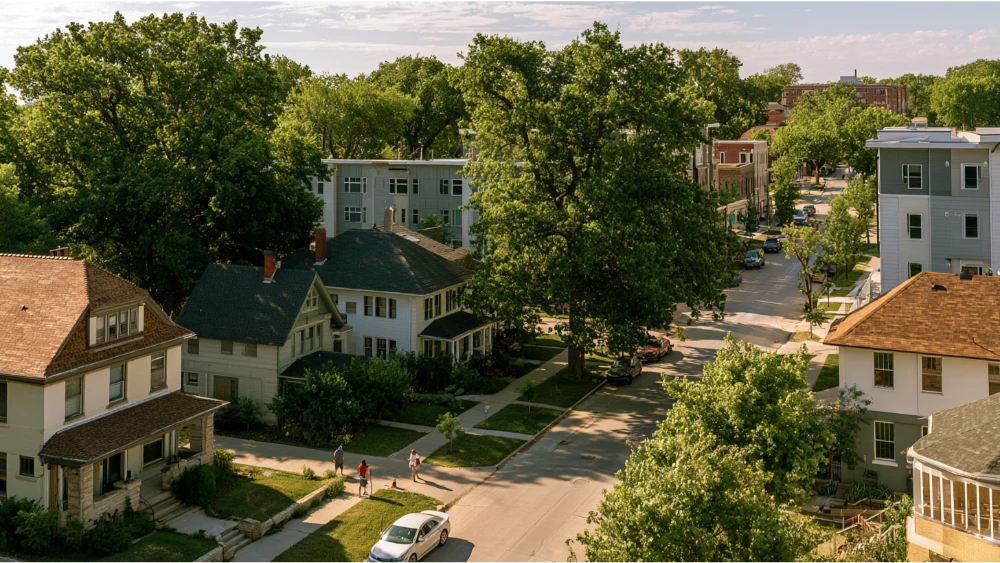
Every figure below carries its date. Point-in-time numbers age fast, so verify before you commit.
| Metric | Figure |
|---|---|
| Population | 97,271 (Census QuickFacts, July 1, 2024) |
| Median household income | $65,009 (Census, 2020–2024, in 2024 dollars) |
| Median gross rent | $1,091 (Census, 2020–2024, occupied units), below the national average |
| Median owner-occupied home value | $292,700 (Census, 2020–2024) |
| Owner-occupancy rate | 43.6% (Census, 2020–2024) |
| Bachelor’s degree or higher, age 25+ | 55.8% (Census, 2020–2024), far above the national average |
| Mean commute | 19.8 minutes (Census, 2020–2024) |
| Households with broadband | 91.6% (Census, 2020–2024) |
| Fixed-route transit fare | $0 (Lawrence Transit, as of September 2026) |
| Largest employment sectors | Government, education and health services, leisure and hospitality (BLS) |
A 43.6% owner-occupancy rate means living in Lawrence, Kansas usually starts with a rental, and the mix of rentals and owner-occupied homes varies block by block.
Is Lawrence, KS a Good Place to Live? Honest Pros and Cons
Advantages:
- A walkable downtown core packed with independent shops, restaurants, and live music venues
- A thriving arts scene plus University of Kansas events and Division I athletics
- 69 city parks and 70+ miles of trails, with a state park lake and wetlands nearby
- Short in-town commutes and fare-free fixed-route buses
- Small town charm and a welcoming community, with entertainment options from bigger cities a short drive east
- A well-educated population that draws students, researchers, and young professionals
Tradeoffs:
- Local wages trail the national average: the Lawrence-area mean wage was $29.30 per hour in May 2025 versus $33.54 nationally (BLS)
- Specialized white-collar fields have a shallower local hiring base
- Housing is not uniformly cheap relative to local income
- The university calendar drives traffic, event parking, and rental turnover
- A car remains useful at many addresses, especially for regional commutes
- Four distinct seasons that require real preparation
Unemployment ran 4.2% in July 2026 (BLS, preliminary and not seasonally adjusted).
What Housing Costs Look Like: Renting vs. Buying in Lawrence
Online rental prices conflict because they measure different things. “Average asking rent” reflects what’s currently listed. Median gross rent is what occupied renter households actually pay, including tenant-paid utilities, and the Census puts that at $1,091 for 2020–2024. Check live asking prices for your exact bedroom count before you budget, since a one bedroom apartment near campus prices differently than one on the west side. Treat the $292,700 Census figure as a median home price benchmark, not a listing price.
The housing stock spans apartments with modern amenities near campus, condominiums, townhouses, historic homes downtown and in Old West Lawrence, and single-family rentals farther west. Affordable housing exists here, but it isn’t spread evenly across the map, and proximity to campus and downtown pushes pricing up. Availability follows the academic calendar, so the widest selection tends to appear in late spring and summer for August lease starts. If you’re buying, verify property taxes for the specific parcel with Douglas County.
Run the numbers before you tour anything. Our Rent Calculator, Rent vs. Buy Calculator, Mortgage Calculator, and Cost of Living Calculator will tell you what a $65,009 median income actually supports here once living expenses are in the mix.
Lawrence Neighborhoods: Old West Lawrence, East Lawrence, and the Rest
Compare Lawrence, Kansas neighborhoods on housing type, proximity, and access, not on labels.
| Area | Housing character | Downtown/campus proximity | Access | Nearby amenities |
|---|---|---|---|---|
| Downtown / Mass Street | Mixed-use lofts and apartments above retail | In it | Strong transit, metered and lot parking | Dining, shops, events, farmers market |
| Oread / campus area | Apartments and older homes on hilly streets | Walk to KU | Pedestrian-heavy, tight parking, event traffic | Campus venues, downtown walk |
| East Lawrence / Warehouse Arts District | Historic housing, galleries and studios | Adjacent to downtown | Bikeable, active city neighborhood plan | Arts spaces, easy access downtown |
| Old West Lawrence | Period homes, brick streets, tree lined streets | Short walk or ride | 6th Street corridor | Downtown, city parks |
| North Lawrence | Older homes, distinct street grid | Across the Kansas River | Easy access to I-70 | Riverfront trails; check address-specific flood info |
| South Lawrence | Post-war and newer residential | Short drive | 23rd Street, K-10 | Prairie Park Nature Center, Baker Wetlands, shopping |
| West Lawrence and northwest | Newer development, suburban neighborhood feel | Farther out | 6th Street, K-10, western routes | Rock Chalk Park, Sports Pavilion, Clinton Lake |
East Lawrence carries a strong sense of place tied to its studios and older housing stock, while West Lawrence leans newer and more car-oriented. Current residents offer valuable insights no map can. Before you sign, verify flood exposure, parking rules, and the actual transit route at the exact address.
The Lawrence Job Market: Who’s Hiring?
Education and research, health care, government, manufacturing, administration, and food service anchor local hiring. In July 2026, BLS reported a labor force of 69,200, employment of 66,300, and 51,500 total nonfarm jobs, with government at 12,700, leisure and hospitality at 7,600, and education and health services at 6,200 (preliminary, not seasonally adjusted, and seasonally variable because of the university calendar). EDC Lawrence listed the University of Kansas (8,845), LMH Health (1,945), and Lawrence Public Schools (1,660) as the largest employers as of December 2025.
By occupation in May 2025, food preparation and serving made up 14.0% of local employment, office and administrative support 10.6%, and educational instruction and library 9.0%. Mean wages: $47.87 per hour for healthcare practitioners, $62.15 for management. If your field is narrow here, weigh openings in Kansas City or Topeka, hybrid roles, or fully remote work. Broadband reaches 91.6% of households, which is why many residents who move here keep an out-of-market employer.
Commuting, Public Transportation, and Getting to Kansas City
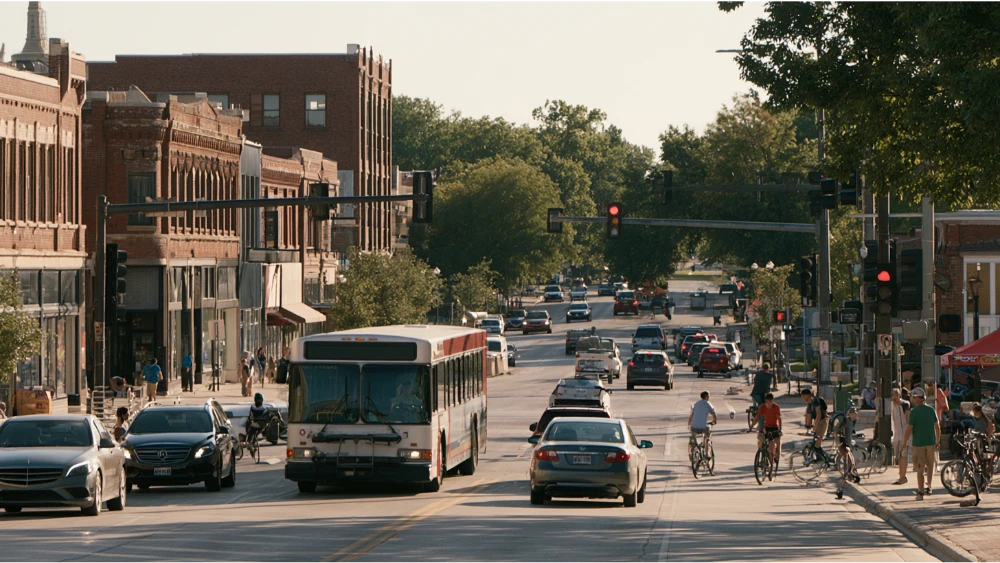
Skip the outdated claim that Lawrence has only limited public transportation. Lawrence Transit fixed-route and paratransit service is fare-free as of September 2026, so there are no monthly passes to buy, and On Demand trips run $3 one way since March 1, 2026. Service generally runs 6 a.m. to 8 p.m., Monday through Saturday, and routes changed in August 2026.
Whether that replaces a car depends on your address, shift, transfers, and weekend needs. Downtown and the campus area are genuinely walkable, and bike lanes connect much of the central grid. I-70 and K-10 carry most regional trips: about 45 minutes to Kansas City, 30 to Topeka, and roughly 45 minutes to Kansas City International per KU relocation info, with real times varying by construction and weather. Test your route from your actual address before signing a lease, and expect traffic congestion near university venues on event days.
Schools and Higher Education
The Lawrence Public Schools district (USD 497) operates 11 conventional elementary schools plus early childhood and virtual options, 4 middle schools, 2 comprehensive high schools, a College and Career Center, and a K–12 virtual school. Choice Campus at Centennial opens for 2026–27, and New York Montessori offers a public Montessori program with district priority and eligibility rules.
Enrollment is required annually, and out-of-boundary transfers depend on the district process and available space. If excellent schools are your top filter, confirm the assigned school for your exact address using the district’s current boundary tool, review Kansas state education performance data, and visit in person before you assume educational excellence at any single building. The University of Kansas reported 31,169 students in fall 2025, and Haskell Indian Nations University is also here, which shapes both the college town feel and the cultural diversity of the local events calendar.
Hospitals and Health Care Access
LMH Health is a 174-bed, community-owned, not-for-profit hospital founded in 1921, with a 24/7 emergency department. It provides primary care, surgery, maternal care, cancer and cardiac care, orthopedics, imaging, and rehabilitation across main and west campuses plus a clinic network. University of Kansas students also have campus health services. Some highly specialized care may mean a trip to the Kansas City region. Locate your nearest primary care clinic and the ER before move-in day.
Food, Local Businesses, and Downtown Lawrence
Massachusetts Street is the spine: coffee shops and bakeries, international kitchens, breweries, vegetarian menus, and chef-driven dining, mostly independent and mostly walkable end to end. Seasonal and year-round farmers markets bring in regional growers. The concentration of local businesses is one reason many residents rank downtown above any mall or strip center, and it doubles as the city’s gathering place during community events.
Things to Do: Arts, Live Music, and Outdoor Recreation
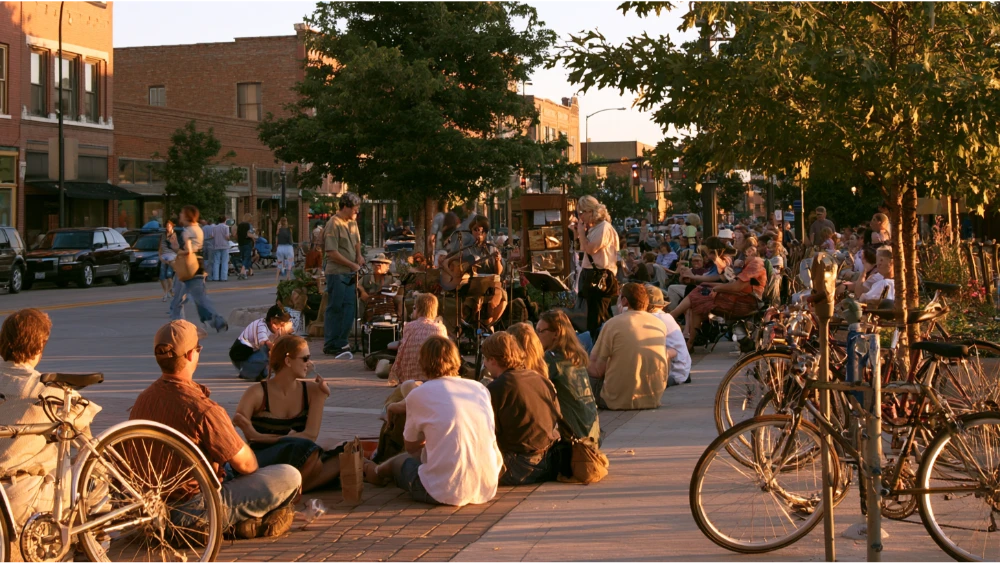
Arts, live music, and community events
The Lawrence Arts Center, art galleries, and live music venues carry the year, and Liberty Hall anchors Massachusetts Street for film and concerts. Monthly Final Fridays pull people downtown, the Busker Festival turns sidewalks into stages, the Free State Festival brings film, art, and music to the calendar, and University of Kansas athletics fills fall and winter.
Outdoor recreation and trails
Outdoor enthusiasts get 69 parks and open spaces across more than 4,000 acres, 37 trails totaling over 70 miles, three recreation centers, a sports pavilion, four swimming facilities, and two off-leash dog parks. Clinton State Park adds about 1,500 acres and 25 miles of hiking and biking trails. Baker University Wetlands has 11+ miles of walking trails, and Prairie Park Nature Center and the Lawrence Loop round out ample opportunities to be outside year-round.
How to Check the Crime Rate and Safety at a Specific Address
Crime rate data is most useful read at the address and time-period level, not as a neighborhood label. Use the City of Lawrence’s official crime map and calls-for-service data, plus the FBI Crime Data Explorer for city-level violent crime and property crime trends. Skip opaque third-party “safest neighborhood” scores.
Weather and Seasonal Prep in Northeast Kansas
Expect humid summer heat, spring thunderstorms and tornado season, and cold stretches with occasional snowfall and ice. The National Weather Service uses a 1991–2020 normal January high of 40.7°F and low of 17.9°F for the area. Temperature swings can be fast. When touring a rental, ask about the age of the heating and cooling systems, insulation, storm shelter guidance, parking, and who handles snow and lawn care.
What to Set Up Before Moving to Lawrence, Kansas
- Confirm your lease start date and which utilities you pay.
- Request city service (water, sewer, solid waste, stormwater) at least three business days ahead and budget the $40 deposit for non-property owners. Bills are due 20 days from the billing date, and trash charges vary by cart size.
- Set up electricity, gas, and internet.
- Get renters insurance and photograph the move-in condition of your Lawrence home.
- Ask whether the unit holds a current city rental license (Lawrence requires one, with periodic inspections on roughly a three-year cycle).
- Test your commute and transit route from the actual address.
- Verify the assigned public school and complete annual enrollment.
- Register vehicles, update your address, and locate primary care and the ER.
- Review pet, parking, and maintenance-request rules in writing.
Timeline: 30 days out, lock the lease and school verification; two weeks out, request utility start and book movers; move-in week, walk your transit route. Budget note: Kansas state sales tax is 6.5% plus local rates, with 0% state tax on qualifying food since January 1, 2025, and Kansas also collects a state income tax, so check your withholding. Use the state’s address-based rate locator.
Is Moving to Lawrence, Kansas Right for You? Your Next Step
This is a great town if you want a university city’s energy, real trail access, a strong sense of community, and a downtown worth walking. If your career is narrow or your budget is tight against local wages, run the math first.
Start with our Cost of Living Calculator and Rent vs. Buy Calculator, then browse rental properties near your target location on our nationwide marketplace. Own rental property anywhere in the U.S.? We handle tenant placement, tenant screening, rent collection, property inspections, and court evictions without you lifting a finger. Call (800) 716-4950, text (608) 207-0657, or email info@ktrents.com and we’ll respond within 24 hours. Since 2009, broker-owned, 683 units and $187M in assets under management as of early 2025 across 34 states as of January 2025, with a 98% occupancy rate (our stated figure). Your Rental. Your Way.
Frequently Asked Questions
Is Lawrence, KS a good place to live?
Yes, for people who want a walkable downtown, arts and live music, university events, and trail access. Compare local wages against your housing budget before you commit.
What is the livable wage in Lawrence, KS?
It depends on household size and housing choice. Median household income was $65,009 (Census, 2020–2024) and the area mean wage was $29.30 per hour in May 2025 against a national average of $33.54. Run your own numbers in our Cost of Living Calculator.
Can you live in Lawrence without a car?
It’s workable near downtown and campus, since fixed-route buses are fare-free and run 6 a.m. to 8 p.m. Monday through Saturday, with On Demand at $3 one way. Your address, work schedule, and weekend plans decide it.
How far is Lawrence from Kansas City and Topeka?
About 45 minutes to Kansas City and 30 minutes to Topeka via I-70 and K-10, per the City of Lawrence. Kansas City International is roughly a 45-minute drive. Times vary with traffic and weather.