

Olathe, Kansas
Homes for rent and for sale — search the map or open the full city SEO catch-all page.
Olathe, Kansas
Moving to Olathe, Kansas means joining a city of about 150,025 residents with a median household income of $114,009, 40 parks covering 3,596 acres, and major employers like Garmin and the University of Kansas Health System all within city limits. The 20.6-minute mean commute runs below the national average, but Olathe is car-dependent, so plan for at least one vehicle per working adult. Median home value is $364,700 and the rental market moves fast, especially for family-sized units.
Moving to Olathe, Kansas
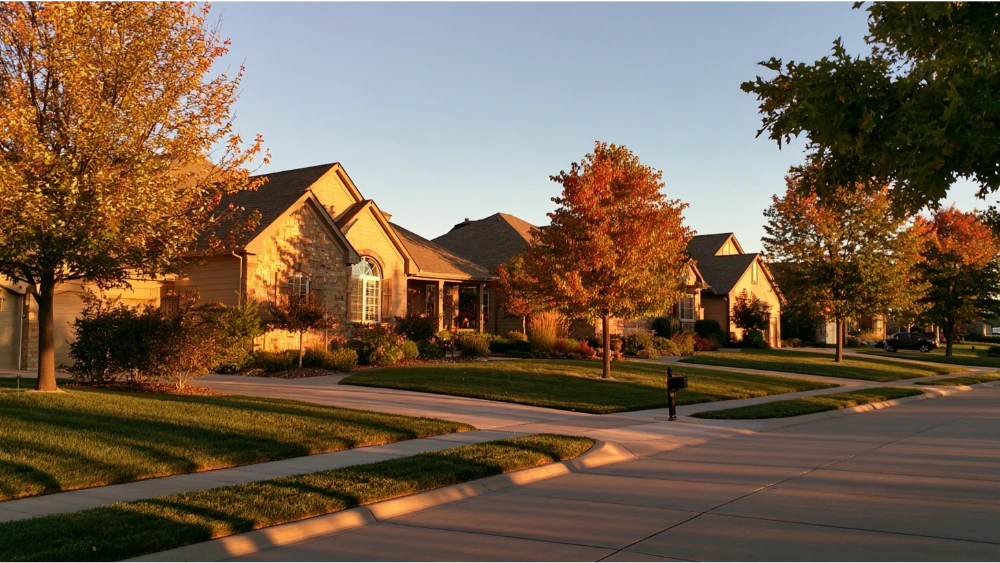
Olathe, KS is a growing Johnson County city of about 150,025 residents (Census estimate, July 1, 2025), sitting roughly 20 miles southwest of downtown Kansas City. It’s the county seat, it has a large public school district, several big employers headquartered or operating inside city limits, and one of the deeper park systems in the metro. The Census-reported mean commute is 20.6 minutes (2020-2024), which lands below the national average commute. It’s also a car-oriented place to live, and that shapes almost every housing decision you’ll make here.
If you’re weighing a lease or a purchase from out of state, here’s what daily life actually looks like for the people who live here, including the practical aspects most relocation guides skip. Three things to keep straight as you read: Olathe-only data is not Johnson County data and neither is Kansas City metro data, Census estimates are not today’s asking rents, and address-specific verification of schools, property taxes, and commute beats any citywide average or best places ranking you’ll find online.
Olathe, KS at a Glance: Population, Median Household Income, and Quality of Life
Every figure below is dated. Use them as a baseline, not a quote.
| Metric | Figure | Source & date |
|---|---|---|
| Population | 150,025 (up 6.2% since April 2020 base) | Census, July 1, 2025 |
| Land area | ~62 square miles | Census, 2020 geography |
| Median household income | $114,009 (2024 dollars) | Census, 2020-2024 |
| Median gross rent | $1,314 | Census estimate, 2020-2024 |
| Median home value | $364,700 | Census estimate, 2020-2024 |
| Owner-occupied rate | 74.8% | Census, 2020-2024 |
| Households with broadband | 95.7% | Census, 2020-2024 |
| Parks / parkland / trails | 40 parks, 3,596 acres, 47 miles of trails | City count, Dec 2025 |
| Average temps | 30°F January, 78°F July | City NOAA-based summary |
Those rent and home value numbers are multi-year survey estimates. Current asking prices move weekly, so check live listings before you sign anything. The median household income line deserves a second look too: at $114,009 in 2024 dollars, it runs well above the national average, and that’s a big part of why housing prices higher here than in much of Kansas. By population, Olathe ranks as the fourth largest city in the state, which is worth knowing if you pictured a small town.
Who Olathe, KS Fits, and Who Should Compare Overland Park and Other Johnson County Communities First
| Olathe likely fits if… | Compare other Kansas City area communities if… |
|---|---|
| You’ll drive daily and want a household with at least one vehicle per working adult | You want to live without a car or rely on frequent transit |
| You work in Johnson County or can accept an I-35 commute into the city | Your job is in central Kansas City and you want a short walk or short drive |
| You want newer construction options alongside older housing stock | You specifically want dense urban apartments and older city housing |
| You want a residential community with parks, trails, and schools a few minutes away | You’d rather live inside a walkable urban core |
| Trails, lake access, and park space matter to your weekends | Late-night entertainment and concert venues are a weekly priority |
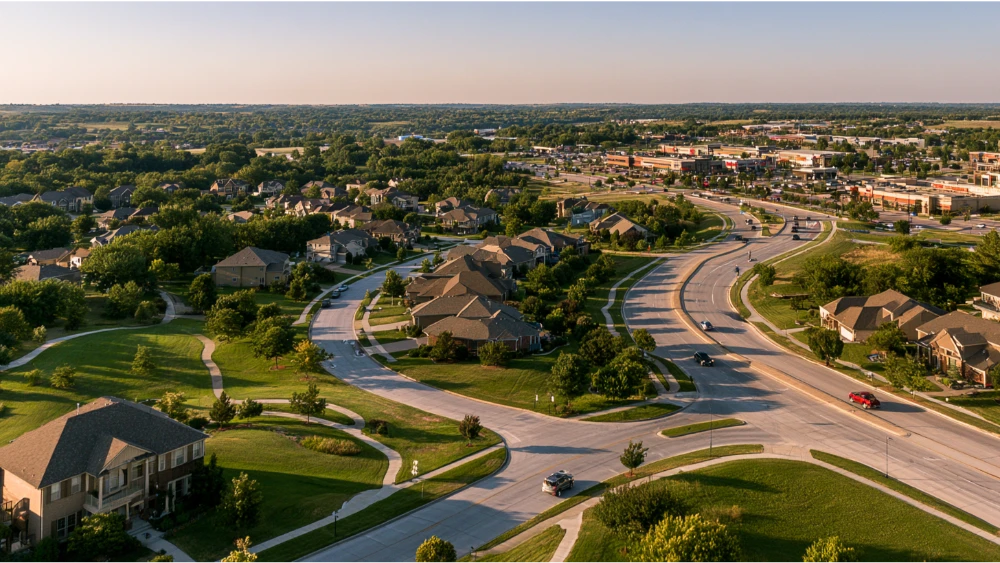
Neighboring Overland Park is the most common side-by-side comparison, and the two cities share highways, employers, and much of the same school-shopping mindset. Much of the Johnson County fixed-route network runs weekday-only, so plan around that rather than hoping public transit fills the gaps in Olathe, KS. Olathe rewards households that are comfortable driving, and it frustrates anyone hoping to test a car-free experiment.
Cost of Living in Olathe, KS: What It Actually Costs to Live Here
The Census baseline for the 2020-2024 period: median gross rent of $1,314, median monthly owner cost of $2,142 with a mortgage and $820 without, and a median home value of $364,700. Median household income was $114,009 in 2024 dollars. MIT’s living-wage model (updated February 15, 2026) estimates a single adult with no children in Johnson County needs $24.41 per hour to cover modeled basic needs, and a family with children needs considerably more. That’s a model, not an official standard or a required wage.
Here’s what most relocation pages and best places lists get wrong: a Census estimate averages several years of survey responses across every existing lease in the city, including long-tenured ones. It is not what a two-bedroom is listing for this month. Treat it as a floor for your expectations, then price actual units in the neighborhoods you’re considering. Affordable housing is relative in a market with this income profile, so define your own ceiling before you tour.
Budget beyond the base rent or payment:
- Utilities. The city’s utility services page notes a 2026 rate increase, so check the current rate page rather than trusting an old monthly estimate.
- Security deposit, application fees, and pet deposits or monthly pet rent.
- Renters insurance.
- Fuel, insurance, and maintenance for the vehicles a car-oriented layout requires.
Comparison sites use different baskets and different dates, so read them loosely. A cost of living index telling you Olathe, KS sits some percentage above or below the national average only helps if you know what’s in the basket. Run your own version through our Cost of Living Calculator with real numbers from real listings.
Renting vs. Buying in Olathe, KS
With a 74.8% owner-occupied rate (Census, 2020-2024), the rental share here is smaller than in denser parts of the metro. Good rentals move, especially family-sized ones with three or more bedrooms, so start your search earlier than you think you need to.
Rent first if your job is new or could relocate you, you’re moving from out of state and haven’t lived in the metro before, or you plan to live here under three years. Buy if your income and location are stable, you plan to stay long enough to absorb closing costs and agent fees, and you want to control renovations and maintenance timing.
Run both scenarios through our Rent vs. Buy Calculator and Mortgage Calculator before you commit either way.
Finding the Perfect Place: Olathe Neighborhoods, Explained
Compare the many neighborhoods here on five objective aspects: housing age, highway and road access, park proximity, commercial access, and nearby construction activity. School lines and city limits don’t always align, so never assume a neighborhood feeds a specific school. The quality of the block you live on matters more than the reputation of the quadrant, and friendly neighborhoods exist in every corner of the city.
Downtown and Original Olathe
Older housing stock, apartments, and the civic and community core, including the downtown library and Johnson County Square. Local businesses cluster within walking distance along Santa Fe and Park Street, and this is where the farmers market and most community events land. The city’s downtown plan calls for added residential density, pedestrian connections, and public spaces while keeping historic character.
Central and East Olathe
Established neighborhoods with relatively direct I-35 access and close proximity to commercial corridors. Housing varies significantly block by block here, so tour at morning and evening commute times instead of trusting broad east-versus-west generalizations about where the best places to live are.
Northwest Olathe and Cedar Creek
Cedar Creek is a formally recognized city planning area near K-7 and K-10, with planned subdivisions and regional road access. Local real estate sources describe the terrain as more wooded and rolling than much of Olathe, KS. Olathe grew outward from its downtown core, so housing age generally tracks distance from the center more than compass direction. Verify the individual property either way.
West Olathe and the Lake Olathe Area
The draw is Lake Olathe Park, and a family that wants water and trails within a few minutes of home tends to look here first. Western addresses are often convenient to K-7 and K-10 but sit farther from I-35, which matters if your commute runs northeast.
South Olathe
A mix of established neighborhoods and newer construction, with major employers and Olathe Hospital nearby. Expansion continues along the 151st through 167th Street corridors, so ask what’s platted next to the property you’re considering. New construction is a quality-of-life question as much as a resale question: today’s quiet cul-de-sac can become next year’s haul route.
Jobs, Employers, and the Local Economy Around Kansas City
Olathe, KS is not only a bedroom community. The local economy carries real employment weight of its own, and job opportunities here span far more than retail. The city’s 2024 financial report lists these principal employers (2024 head counts):
- Garmin International: 4,415
- Olathe Unified School District: 4,309
- The University of Kansas Health System: 2,500
- Johnson County Government: 2,500
- City of Olathe: 1,068
- FedEx distribution operations: 924
- Honeywell: 900
- TVH: 720
- TransAm Trucking: 700
- Sysco Food Services: 600
For metro context, the Kansas City metropolitan area posted a 3.8% preliminary unemployment rate in July 2026, with roughly 1.178 million nonfarm jobs, up 0.7% year over year. Those are metro figures, not Olathe-only. The mix here leans toward technology, health care, education, logistics, government, and professional services, which is a more diversified economy than a one-employer town, and it means plenty of people live within a few miles of where they work. If you’re bringing a business with you, the city and county both publish resources on permitting and technical assistance for new employers. Remote professionals should note the 95.7% household broadband rate (Census, 2020-2024), comfortably above the national average, and prioritize a floor plan with a real office door, because square footage here often comes cheaper than it does closer to the core.
Commuting, Highways, I-35 and Santa Fe: Can You Live in Olathe Without a Car?
Short verdict: Olathe, KS is car-oriented. Plan for at least one vehicle per working adult in most households.
The 20.6-minute mean commute (Census, 2020-2024) reflects the many residents who both live and work inside Olathe or elsewhere in Johnson County. If you’re headed to downtown Kansas City, expect longer. I-35 is the primary connector to the central city, with K-7, K-10, U.S. 169, and I-435 handling other directions.
RideKC lists Olathe-area weekday services, including the 403 Antioch to Olathe route and the 520 Strang Line Express. Much of the county’s fixed-route network is weekday-only, so it can support a commute but rarely a car-free life.
One more thing to check before you sign: the I-35 and Santa Fe corridor improvement project. Utility relocation began in 2026 and is expected to continue through summer 2027, with intermittent lane closures. Santa Fe is a main east-west spine through the middle of the city, so residents on either side of it should check the city’s project page for the current schedule, then drive the actual route at the actual hour.
Kansas City International Airport is approximately 35 miles away, depending on your starting point and route.
Olathe, KS Schools and the Boundary Changes Under Review
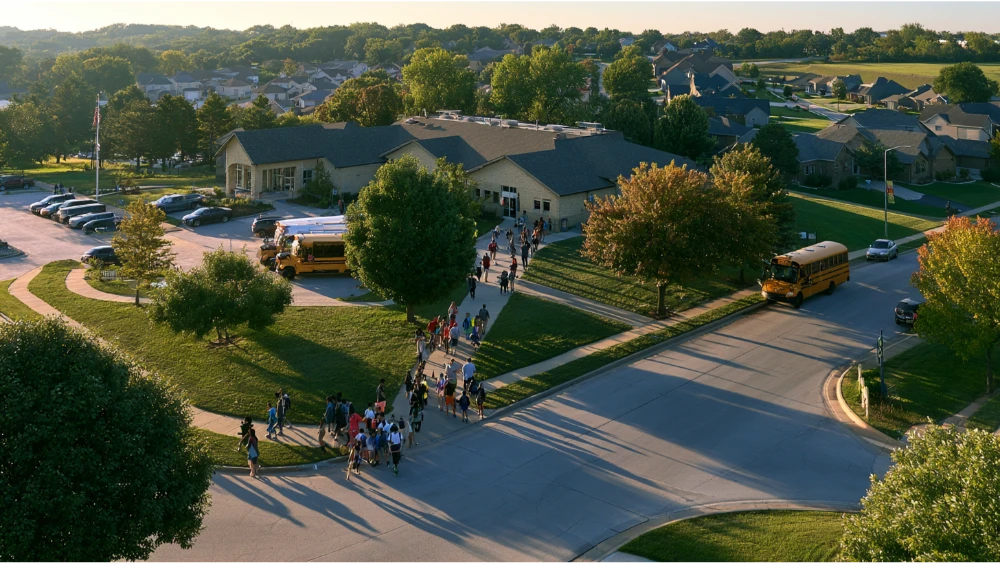
Olathe Public Schools reports more than 28,000 students, 58 schools and facilities, 91 languages spoken, and 31 career pathways, with a district-reported graduation rate of about 95%. That language count is one of the clearest markers of the diversity families notice once they arrive. Beyond standard pathways, the district runs two-year technical academies and application-based four-year academies in areas including engineering, computer science, medical professions, public safety, design, finance, and animal health. School quality is one of the most common reasons families give for moving to Olathe Kansas, and it’s also the thing most worth verifying yourself instead of taking it from a ranking site.
Pending changes, as of September 2026 (proposed, not final): The district has recommended closing five elementary schools (Black Bob, Heritage, Scarborough, Tomahawk, and Walnut Grove) plus Indian Trail Middle after the 2026-27 school year. A public hearing was scheduled for September 22, 2026, with Board consideration expected in October 2026. If approved, closures would begin in 2027-28, and boundary changes would be developed afterward. No changes have been announced for 2026-27. Verify the current status on the district’s boundaries page before you make a decision.
Use the district’s school locator for an address-specific assignment. Boundaries can cross municipal lines, transfers are not automatic, and where you live by a few hundred feet can change the assigned school. Private and parochial schools operate in the area as well.
Hospitals and Public Services in KS Olathe
Olathe Hospital, part of The University of Kansas Health System, is a not-for-profit medical center with a full-service emergency department open 24 hours a day, seven days a week. The health system describes it as a certified chest pain center and an advanced primary stroke center. The Quivira Campus adds orthopedics, rehabilitation, plastic surgery, urology, lab, imaging, and outpatient surgery services locally. Other public services, from libraries to police and fire, are administered through the city and Johnson County.
There’s a difference between having a hospital in town and having your specialty covered in town. Some specialty and pediatric care means driving elsewhere in Johnson County or into the metro. Confirm your in-network providers before you sign, especially if a family member sees a specialist regularly.
Outdoor Activities: Parks, Trails, Heritage Park, and Festivals
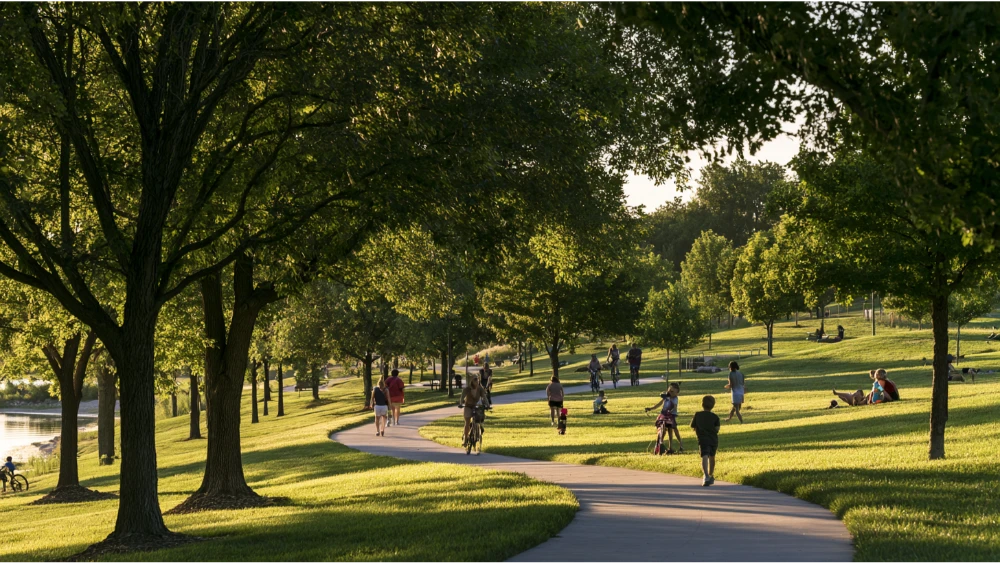
This is where Olathe’s numbers do the talking. As of December 2025, the city counts 40 neighborhood and community parks, 3,596 acres of parkland, and 47 miles of public trails, plus roughly 26.5 miles of bike lanes, 26.4 miles of multi-use trails, and 13.5 miles of trails inside parks. Recreational options run year-round, and the amenities are close enough to most homes that weekend plans rarely require a highway.
Lake Olathe Park anchors the west side with a 170-acre lake across 258 acres of park space, four miles of trails, a marina, swim beach, spray ground, playgrounds, an 18-hole disc golf course, and an amphitheater seating roughly 1,500. The amphitheater is built for warm-weather events, so check the parks calendar before you plan a weekend around it.
Mahaffie Stagecoach Stop & Farm preserves a working piece of Santa Fe Trail history, with the stagecoach stop still in operation as a historic site. Ernie Miller Park and Nature Center and Heritage Park cover the hiking and nature-program side. Olathe hosts a farmers market, public sculpture exhibits, seasonal festivals, and programming at the Olathe Community Center. Spring and fall belong to the trails, summer belongs to the lake, and community events cluster downtown year-round. It’s an easy calendar to build fun into with friends once you know where to look.
Food, Shopping, and Local Culture
Dining in Olathe, KS splits into two patterns. Downtown holds the walkable cluster of independent, locally operated spots, and the city’s downtown plan supports growing that mix of retail, civic, and gathering space. The bigger concentrations of restaurants and places to shop sit along the commercial corridors: 119th Street, Black Bob Road, and 135th Street, where national and regional names dominate.
Be realistic about nightlife. Late-night entertainment, larger concert venues, and destination dining still skew toward central Kansas City, roughly 20 miles up I-35. Plenty of residents make that drive a few times a month and call it a fair trade. Restaurants open and close constantly, so use a current, regularly updated dining guide rather than a list from a relocation article. The culture here is neighborhood-first, and most newcomers find that meeting neighbors happens faster at a park or a school event than at a bar.
Weather: Humid Summers, Cold Winters, and Storm Season
Four distinct seasons. The city’s NOAA-based summary puts average January temperatures at 30°F, average July at 78°F, and annual precipitation around 37 inches (rain and snow grouped together).
Practically: humid summers bring real heat, cold winters bring ice, and spring brings thunderstorms, hail, and tornado warnings. Ask your lease who handles snow removal before winter arrives. Sign up for local emergency alert services, follow National Weather Service guidance for severe weather, carry renters insurance, and know your property’s shelter location before storm season. New residents from milder climates usually underestimate the ice more than the heat.
Property Taxes, Sales Tax, Utilities, and Moving Logistics
Kansas dropped its state sales tax on qualifying food and food ingredients to 0% on January 1, 2025, though county and city taxes may still apply and prepared food generally remains fully taxable. Olathe’s page shows a general combined rate around 9.475%, but special taxing districts can push it higher, so verify your exact address against the Kansas Department of Revenue’s current quarterly rate file. Property taxes combine city, county, school, and other taxing entities, so never treat one mill levy as the whole bill. If you’re comparing against the state you’re leaving, look at the effective rate on a specific address rather than a state-level figure or a national average.
Your pre-move sequence for settling into a new city:
- Verify address-level sales tax and property tax.
- Set up utility services and internet (the city notes a 2026 rate increase).
- Confirm Kansas driver’s license and vehicle registration deadlines with current state sources.
- Update insurance and voter registration.
Honest Pros and Cons of Living in Olathe, KS
Pros: a substantial local economy rather than pure bedroom-community status, 3,596 acres of parkland and 47 miles of trails, 24/7 emergency services in town, schools with a wide range of career pathways, housing variety from older downtown stock to new construction, and roughly 20 miles to downtown Kansas City. Parks, employers, and schools sitting this close together are a big part of what’s making Olathe a repeat pick for relocating households.
Cons: real car dependence and weekday-only fixed-route transit, pending school closure and boundary decisions, housing costs above some other Kansas markets, I-35 and Santa Fe construction running into summer 2027, and distance from central-city nightlife.
On safety: you’ll see Olathe, KS marketed on best places lists with claims about low crime rates. Skip the rankings. A citywide crime rate means nothing without a reporting year, a clear violent-versus-property definition, and a population basis, and low crime rates measured citywide tell you very little about the two blocks around your front door. Pull the police department’s current crime map and annual report, then evaluate the specific area where you’ll live.
Before You Sign a Lease or Buy: Your Olathe, KS Checklist
- Drive your commute at rush hour, both directions. The 20.6-minute average is not your number.
- Verify the assigned school by exact address, and check the district’s boundary page for the 2027-28 proposal status.
- Check active road projects on your route, including I-35 and Santa Fe.
- Ask for utility cost history on the specific unit or home.
- Confirm pet policy, deposits, and who handles maintenance and snow removal.
- Ask how maintenance requests are submitted and what typical turnaround looks like.
- Run the cost of living and rent-versus-buy numbers with real listing prices.
- Locate the nearest park, community center, and grocery store, then walk the immediate area at different times of day.
Frequently Asked Questions
Is Olathe, KS a good place to live?
It fits residents who will drive daily and want park access, a local job base, schools with a range of career pathways, and housing variety. The Census estimates the population grew 6.2% between April 2020 and July 2025, which suggests plenty of people find the tradeoffs worth it. Car dependence is the honest downside.
Is moving to Kansas a good idea?
It depends entirely on your job and commute. For the Kansas City metro specifically, unemployment was 3.8% (preliminary, July 2026) with about 1.178 million nonfarm jobs, up 0.7% year over year. Compare your actual offer against the housing you’d get on each side of the state line, and against the cost of living where you live now.
Why are so many people moving out of Kansas?
That premise doesn’t hold in Olathe, KS. Olathe grew 6.2% from the April 2020 base to an estimated 150,025 residents as of July 1, 2025. Statewide trends and individual city trends are different things, so check the city you’re actually considering.
What is the median household income in Olathe?
$114,009 in 2024 dollars, per the Census 2020-2024 estimate. That’s a citywide median for all households, not a typical salary, and it sits above the national average, which helps explain local home prices.
Is it cheaper to live in KS or MO?
Neither state is uniformly cheaper. Tax structures, sales tax by district, property taxes, and housing costs all vary by address. Kansas dropped state sales tax on qualifying groceries to 0% in January 2025, but local rates still apply. Compare specific addresses and your own cost of living math, not states.
Are Olathe schools closing or changing boundaries?
As of September 2026, the district has proposed closing five elementary schools and one middle school after 2026-27, with Board consideration expected in October 2026 and any changes starting in 2027-28. Nothing is final. Verify current status on the district’s boundaries page.
Ready to Find Your Perfect Place in Olathe, KS? Run the Numbers First
Start with our Cost of Living Calculator, Rent vs. Buy Calculator, and Mortgage Calculator, then browse current Kansas City area rental listings to see what’s actually available in the neighborhoods you like.
Buying an investment property in the metro? KT Rents is a full-service, broker-owned property management company operating since 2009, with 683 units across 34 states and $187M in assets under management as of early 2025 and a reported 98% occupancy rate. We handle tenant placement, tenant screening, rent collection, property maintenance, rental permits, 1099s, property inspections and court evictions without the owner lifting a finger. Call (800) 716-4950, text (608) 207-0657, or email info@ktrents.com. We respond within 24 hours.
Your Rental. Your Way.