

Missoula, Montana
Homes for rent and for sale — search the map or open the full city SEO catch-all page.
Missoula, Montana
Moving to Missoula, Montana means settling in a university city of roughly 78,903 people where the cost of living runs about 15 to 16 percent above the national average, driven almost entirely by housing. The 2025 median urban-area sale price hit $550,000, and one-bedroom rentals commonly list at $1,400 to $1,700. Upsides include a 15.8-minute average commute, zero-fare public transit, and direct access to over 5,000 acres of conservation land.
Moving to Missoula, Montana
Information verified October 2026. Check live rents and listings before you build a budget.
Missoula is a university town of roughly 78,903 people (Census estimate, July 1, 2025), ringed by five mountain ranges and built where three rivers meet. You get zero-fare public transportation, a 15.8-minute average commute, and an economy anchored by healthcare and education. The tradeoffs are real: housing costs have outrun local wages, late-summer wildfire smoke is a recurring fact of life, and winters are long.
This guide is for anyone weighing a move and needing an honest go/no-go on budget, work, and daily living. Two things shape everything below. City, county, and metro figures describe different places, so we label every number. And “median gross rent,” “HUD Fair Market Rent,” and “current asking rent” are three different measures, only one of which belongs in your budget.
Missoula, Montana at a Glance
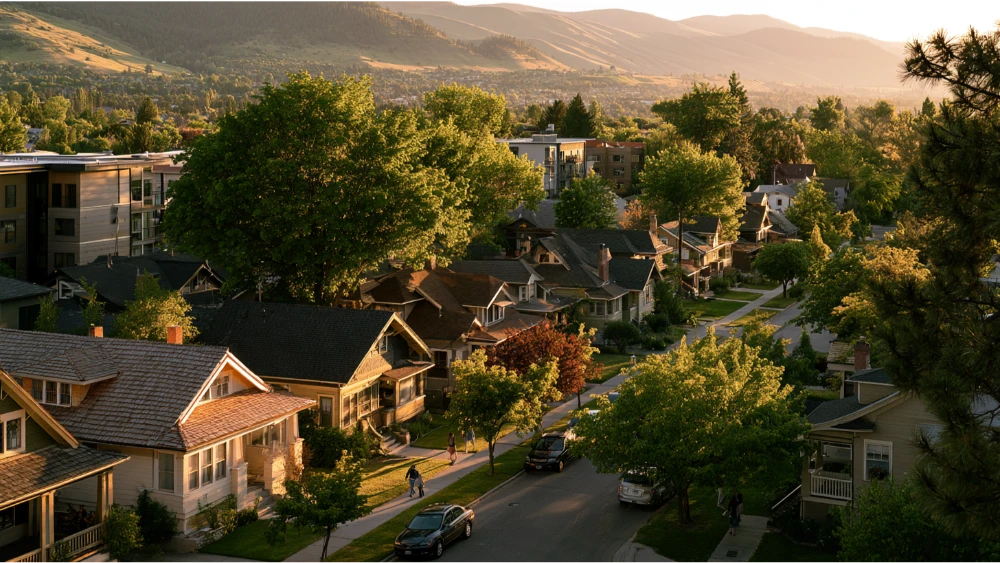
Memorize these before you start browsing housing options. Everything is city-level unless noted, and county and metro figures generally run higher.
| Measure | Figure | Source and date |
|---|---|---|
| City population | 78,903 | Census estimate, July 1, 2025 |
| Growth since 2020 base | 6.4% | Census, 2020 to 2025 |
| Households | 34,941 | Census 2020 to 2024 |
| Median household income | $70,392 | Census 2020 to 2024 |
| Median gross rent | $1,189 | Census 2020 to 2024 (not current asking rent) |
| Median owner-occupied value | $473,100 | Census 2020 to 2024 |
| Median urban-area sale price | $550,000 | Five Valleys Housing Report, 2025 sales |
| Homeownership rate | 47% | Census 2020 to 2024 |
| Mean commute | 15.8 minutes | Census 2020 to 2024 |
| Metro unemployment | 2.8% | BLS, preliminary, August 2026 |
| University of Montana enrollment | 11,319 | Fall 2026 |
What Does the Cost of Living in Missoula Cost Compared to the National Average?
Commonly cited indexes put Missoula around 15 to 16 percent above the national average, and housing drives nearly all of that gap. Groceries, utilities, and transportation land closer to typical, which keeps day-to-day living more affordable than the headline number suggests.
Montana has no general sales tax in 2026, though lodging, rental cars, fuel, and alcohol carry their own. Income tax for 2026 runs 4.7% on taxable income up to $47,500 for single filers ($95,000 jointly) and 5.65% above that.
Here’s what a single affordability score hides: the mismatch between what local jobs pay and what local housing costs. Average annual wages in Missoula County were about $56,900 in 2023, while the 2025 median urban-area sale price hit $550,000. Run your own numbers in our Cost of Living Calculator before moving to Missoula or anywhere else.
Housing in Missoula: Rent, Housing Options, and How Buying Compares
Missoula offers housing options ranging from downtown Missoula lofts and campus-area duplexes to older bungalows and newer subdivision homes on the valley’s edges. Three rent numbers float around online, and they mean different things:
- Census median gross rent, $1,189 (2020 to 2024). A multi-year average that lags the live market. Useful for trend context, not budgeting.
- HUD FY 2026 Fair Market Rent. Studio $1,143, one bedroom $1,400, two bedrooms $1,655, three bedrooms $2,302, four bedrooms $2,776. An administrative benchmark including utilities, not a listing price.
- Current asking rent. What you’ll actually pay. One-bedroom units commonly list in the $1,400 to $1,700 range.
The market has tightened. Multifamily vacancy was 6.8% in Q1 2025, or 4.7% excluding new buildings still leasing up. Units renting above $1,500 grew from 7% of rentals in 2019 to 25% in 2023, and 30% of renters were paying at least half their income toward housing by 2023.
Buying is no easy escape: 1,029 homes sold in the urban area in 2025 at that $550,000 median. Compare both paths honestly with our Rent vs. Buy Calculator and Rent Calculator before committing to a new home.
Best Neighborhoods in Missoula: How to Compare Them
Missoula neighborhoods differ more by terrain and amenities than by any ranking site’s score. Compare them on housing type, distance to downtown Missoula, transit and trail access, slope, and nearby amenities like groceries, parks, and clinics.
| Neighborhood | Typical housing | To downtown | Transit & trails | Terrain and notes |
|---|---|---|---|---|
| Downtown / Heart of Missoula | Apartments, condos, lofts | Walkable | Top bus frequency, Riverfront Trail | Flat, most retail and dining |
| University District | Older homes, rentals, multi-family | 5 to 10 min | Strong transit, M Trail | Flat, walkable to campus |
| Lower & Upper Rattlesnake | Single-family, duplexes | 5 to 15 min | Rattlesnake route, trail corridor | Rising terrain, wilderness access |
| Northside / Westside | Older homes, newer infill | Under 5 min | Bus service, close to trails | Flat, near rail corridor |
| Lewis and Clark | Bungalows and condos | 5 to 10 min | Near campus and bus lines | Gently sloped |
| Riverfront & Rose Park | Single-family, older stock | 5 to 10 min | Riverfront Trail adjacent | Flat, near Clark Fork (check flood maps) |
| Franklin to the Fort | Single-family and apartments | 10 min | Fort Missoula bus service | Flat, near Fort Missoula Regional Park |
| South Hills, Farviews & Miller Creek | Newer subdivisions | 10 to 20 min | South Hills route, Pattee Canyon | Hilly, valley views, car-oriented |
| Grant Creek | Newer homes, condos | 10 min | Limited transit, trail access | Sloped, north of I-90 |
Several neighborhoods press right up against the mountains, which buys you hiking from your doorstep and a steeper driveway to shovel in January. A neighborhood name and a school attendance boundary are not the same thing, so verify the exact address.
Jobs and the Local Economy: Who’s Hiring in Missoula?
Missoula County’s largest employment sectors in 2023 were healthcare and social assistance (11,050), retail trade (8,800), accommodation and food services (6,950), educational services (5,850), and professional and scientific work (4,660). Metro unemployment was 2.8% in August 2026 (BLS, preliminary). Montana’s minimum wage rose to $10.85 an hour in January 2026.
Most guides stop there. Here’s the part they skip: low unemployment means finding work is realistic. It does not mean the first job you find will cover Missoula rent. Remote professionals and small businesses make up a meaningful share of this community’s economy, and for many residents a remote salary from a higher-wage market is what makes the math work.
Schools and the University of Montana
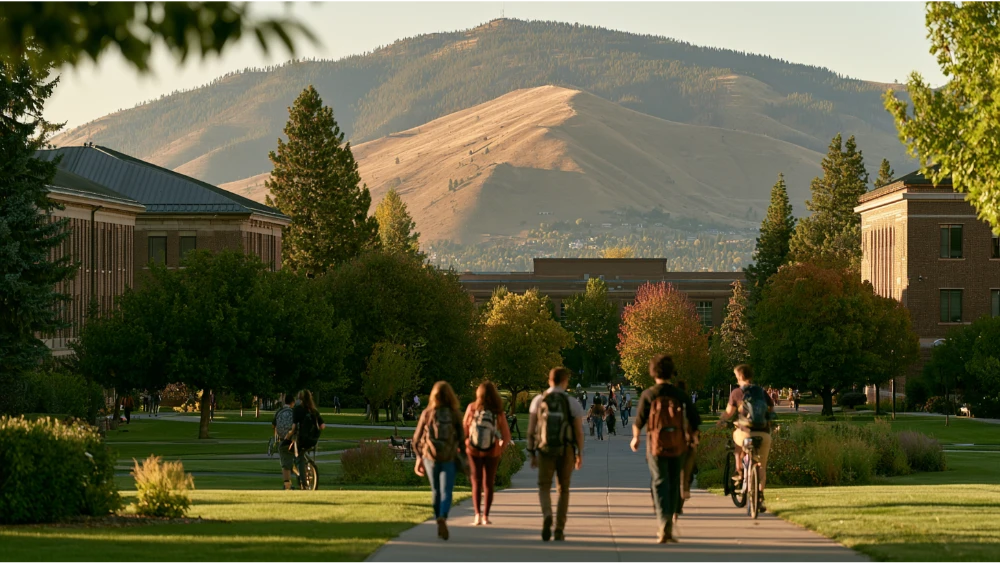
Skip the “good schools” label and follow a process. Use the Missoula County Public Schools address-search tool to find your assigned elementary, middle, and high school, plus bus stops and walking zones. Then review Montana OPI’s ESSA report cards for enrollment, academic growth, attendance, graduation, and per-pupil spending. Out-of-district placement requires an application, and continued enrollment may require reapplying.
The district includes nine neighborhood elementary schools, three middle schools, three main city high schools, plus charter, online, and alternative programs. Hellgate High School offers the International Baccalaureate program, and independent options like Sussex School exist alongside the district. Outdoor education runs through many of them.
The University of Montana enrolled 11,319 students in fall 2026, including 2,937 graduate students and 1,726 at Missoula College. If you are comparing college towns, note that Montana State University sits in Bozeman, roughly three and a half hours east, and anchors a different community entirely. Missoula’s campus drives jobs, arts, athletics, and a large share of rental demand.
Hospitals and Healthcare in Missoula
Missoula offers two hospital campuses. Providence St. Patrick Hospital is an ACS-verified Level II Trauma Center and a state-designated regional trauma center with 24/7 emergency care. Community Medical Center is a Level IV Trauma Center and accredited chest-pain center with pediatric emergency care, cardiology, oncology, orthopedics, rehabilitation, surgery, and women’s and newborn services.
The city functions as the regional medical hub for western Montana, which matters to residents across a wide rural area. If anyone in your household needs ongoing specialty care, weigh that above almost any other relocation factor.
Getting Around Missoula: Transportation and Do You Need a Car?
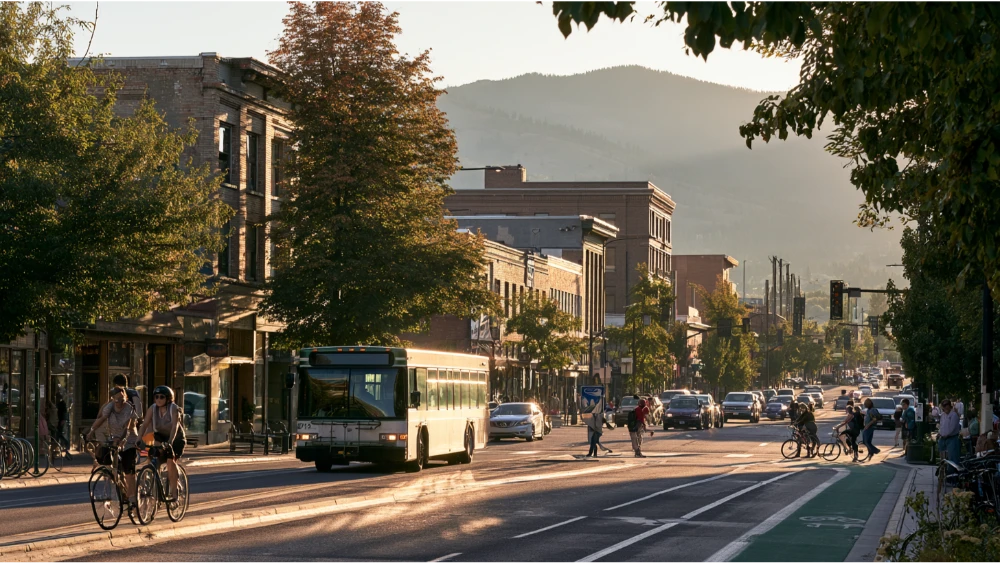
Not necessarily, if you live near downtown Missoula, the university, or a frequent transit corridor. A car still helps for trailheads, skiing, outer neighborhoods, and shifts that don’t match bus schedules.
Mountain Line runs zero-fare bus transportation serving downtown, campus, the airport, medical centers, the Rattlesnake, Northside, East Missoula, South Hills, and Fort Missoula. Route 11 provides daily zero-fare airport service, roughly hourly on weekdays. The city’s 22 miles of commuter trails make year-round bike commuting realistic. Routes change (Route 8 ended in July 2026), so confirm current service before you sign a lease. Missoula Montana Airport offers year-round and seasonal nonstops; verify destinations at flymissoula.com.
Weather, Wildfire Smoke, and Environmental Risks
Four distinct seasons, snowy and icy winters, warm-to-hot summers. Two things relocation pages minimize. Wildfire smoke is the first: Missoula County posted repeated advisories through August 2026, ranging from moderate to unhealthy, and advises planning for cool, filtered indoor air. Valley inversions trap winter air as well.
Flooding is the second. The city sits along several rivers and creeks, and FEMA adopted updated county maps in October 2023 with preliminary updates in 2025, so check the specific property rather than the neighborhood. Before you sign:
- Confirm air filtration and cooling, and ask whether AC is included
- Look up the exact address on current FEMA flood maps
- Ask who handles snow removal and sidewalk clearing
- Check winter parking rules for the street
- Opt into Smart911 emergency alerts
For temperature and snowfall norms, use the National Weather Service Missoula climate page, not generic relocation sites.
Outdoor Recreation Opportunities and Things to Do Year-Round
Missoula offers more than 500 acres of developed parks across 50-plus sites, about 5,000 acres of conservation land, 22 miles of commuter trails, 63 miles of natural-surface trails, and over 35,000 city trees. Nature is not a weekend amenity here. It’s the baseline of daily life.
The Clark Fork River and Riverfront Trail cut straight through town, and the Bitterroot and Blackfoot rivers join nearby for fishing and floating. Mount Sentinel and the M Trail rise above campus on roughly 1,000 acres of native prairie. Mount Jumbo, the Rattlesnake National Recreation Area, Marshall Mountain, Fort Missoula Regional Park, and Caras Park round out the hiking, biking, and winter options.
Culture holds its own against the stunning natural beauty: farmers markets, Griz athletics, live music and theater, museums and galleries, River City Roots Festival, the Missoula Marathon, the Western Montana Fair and Rodeo, and the Big Sky Documentary Film Festival. Dates shift, so check Destination Missoula.
Safety and Choosing the Right Property
Ignore ranking-site verdicts on whether neighborhoods are “safe.” Conditions vary by block, hour, property, and incident type. Review the Missoula Police Department’s latest annual report, then visit the exact block during the day and again in the evening. Check lighting, locks, entry points, and parking. Ask the landlord or property manager how maintenance requests are submitted and how fast they’re handled. A professional, broker-owned manager answers that in writing. An unlicensed one often won’t.
Your 60-Day Checklist for Moving to Missoula Montana
- Secure housing and confirm your lease start date.
- Transfer utilities and schedule internet installation.
- Update renters or homeowners insurance for your new home.
- Transfer an out-of-state noncommercial driver’s license within 60 days (CDL holders: 30 days).
- Title and register vehicles within 60 days of establishing residency.
- Enroll children using the MCPS address-search tool.
- Opt into Smart911 emergency alerts.
- Stock winter gear, snow removal supplies, and an air purifier before August smoke season.
MVD rules change. Verify current requirements before you go.
How to Find a Rental That Actually Fits
Order of operations matters. Set a real housing budget with our Cost of Living Calculator and Rent Calculator. Weigh renting against that $550,000 median sale price using the Rent vs. Buy Calculator. Map your commute and transit access. Verify school assignment by address. Confirm pet terms, parking, cooling, and snow-removal responsibility, then ask how maintenance requests get answered.
Then Browse Rental Properties Near You on our national marketplace and check current availability. Questions? Call (800) 716-4950 or email info@ktrents.com. We respond within 24 hours. Your Rental. Your Way.
Frequently Asked Questions
Is Missoula, Montana a good place to live?
Yes, if you want daily access to mountains and rivers, university-town culture, and a short commute. The average commute is 15.8 minutes (Census 2020 to 2024). The honest caveat is housing cost relative to local wages.
How much do you need to make to live in Missoula, MT?
Work backward from rent. At $1,400 to $1,700 for a one-bedroom and the 30%-of-income guideline, that’s roughly $56,000 to $68,000 for one person. Median household income was $70,392 (Census 2020 to 2024), and 30% of renters were severely cost-burdened in 2023.
What is the downfall of living in Montana?
Housing costs rising faster than wages, wildfire smoke in late summer, long winters, and long drives for regional travel and some specialty care. None are dealbreakers alone, but they compound.
Is Missoula expensive compared to the rest of Montana?
Anyone moving to Missoula Montana from elsewhere in the state will find one of its most competitive markets, with a $550,000 median 2025 urban-area sale price and tight rental inventory. Overall cost of living runs roughly 15 to 16 percent above the national average, driven almost entirely by housing.