

Asheville, North Carolina
Homes for rent and for sale — search the map or open the full city SEO catch-all page.
Asheville, North Carolina
Moving to Asheville, North Carolina means gaining Blue Ridge mountain access, a strong arts and food scene, and an 18.2-minute mean commute, but housing costs are steep: median gross rent runs $1,402 and a two-bedroom Fair Market Rent hits $1,866 against a $71,102 median household income. Flood research at the address level remains essential while Hurricane Helene recovery continues across nearly 200 city sites.
Moving to Asheville North Carolina
Asheville sits in the Blue Ridge range of the Appalachian Mountains, with deep arts and food culture, a short drive to work (mean commute 18.2 minutes, ACS 2020–2024), and jobs in healthcare, hospitality, administration, manufacturing and professional services. The catch is price. Housing costs run high against local wages, and property-level flood research still matters while Hurricane Helene recovery continues.
This guide is for renters, relocating households and remote professionals: housing numbers with dates attached, neighborhoods, schools, hospitals and a moving checklist. One distinction first. ACS median gross rent is what current renters pay, utilities included. HUD Fair Market Rent is a 40th-percentile estimate for the whole metro. Advertised asking rent is what’s listed today. They measure different things. Last researched October 6, 2026.
Asheville NC at a Glance
| Measure | Figure | Source & Date |
|---|---|---|
| Population (city) | 93,523 | Census, July 1, 2025 |
| Median household income | $71,102 | ACS 2020–2024 |
| Median gross rent | $1,402 | ACS 2020–2024 |
| Two-bedroom Fair Market Rent (metro) | $1,866 | HUD FY2027 |
| Median owner-occupied home value | $440,000 | ACS 2020–2024 |
| Mean commute | 18.2 minutes | ACS 2020–2024 |
| Unemployment rate (metro) | 3.1% | BLS, Aug 2026, preliminary |
| July / January normal high | 85.3°F / 48.9°F | NOAA 1991–2020 |
Pros and Cons of Living in Asheville NC
- Mountains at your doorstep. Plenty of trails, parkway drives and river access within minutes.
- Arts, food and live music. Galleries, working studios, many restaurants, concerts most nights.
- Craft brewing. The “Beer City USA” scene clusters downtown and on the South Slope.
- Major hospital access and a regional airport.
- Locally owned businesses, four real seasons and a mild winter compared with northern states.
- Housing costs outrun local wages. That is the central tension here.
- You’ll want a car outside the corridors where public transportation works.
- Tourism traffic spikes in fall and on summer weekends.
- Flood, drainage and slope need address-level research, not a listing photo.
- Rental availability tightens at certain price points.
Housing Costs in Asheville NC: What Renters and Buyers Actually Pay
Three numbers, three meanings. The ACS median gross rent of $1,402 (2020–2024) is what existing renters paid, utilities included, across a five-year window. HUD’s FY2027 Fair Market Rents for the Asheville MSA (Buncombe, Henderson, Madison counties) land at $1,482 studio, $1,714 one-bedroom, $1,866 two-bedroom, $2,223 three-bedroom, all 40th-percentile estimates rather than averages. One rental marketplace reported October 2026 apartment averages near $1,433 for a one-bedroom, down about 1.1% year over year. Treat that as a volatile snapshot.
Owner-occupied homes carried a median value of $440,000 and median monthly owner costs of $1,886 with a mortgage (ACS 2020–2024). A commonly cited local estimate puts the income needed to maintain living standards near $78,363, above the $71,102 median household income. That gap decides what you can afford. Budget for deposits, utility setup, parking, renters insurance, pet terms and the truck, then run your numbers through our Rent Calculator and Cost of Living Calculator.
The Asheville NC Job Market: Unemployment Rate, Wages, and Opportunities
The metro posted a 3.1% unemployment rate in August 2026 (preliminary) across roughly 187,900 nonfarm jobs, up 0.7% year over year. The largest occupational shares: office and administrative support (11.4%), food preparation and serving (10.8%), sales (10.0%), transportation and material moving (8.7%), healthcare practitioners (8.2%). Healthcare alone accounted for 14,890 jobs in May 2025, including about 4,680 registered nurses. Major employers cluster in education and health services, leisure and hospitality, government and retail.
Here’s the part other guides soften. The May 2025 mean wage was $29.08 per hour against a national mean of $33.54, while housing runs high. Remote workers on out-of-market salaries and dual-income households land easiest. Choose geography on purpose, and this job market pairs mountain access with real career opportunities.
Asheville NC Neighborhoods and Nearby Places: Where Should You Live?
Compare on five objective things: housing type and age, proximity to work and shopping, driving or transit practicality, terrain and slope, and what the flood maps say for that exact address.
- Downtown Asheville and the South Slope: condos and apartments, walkable, breweries at street level.
- Montford: historic homes minutes from downtown.
- North Asheville and Grove Park: established historic homes near the Omni Grove Park Inn.
- West Asheville: bungalows, shops and restaurants along Haywood Road, with bus access.
- East Asheville, Haw Creek, Oakley, Kenilworth: older mixed stock, central commutes, hillier terrain.
- South Asheville and Arden: Biltmore Park offers newer homes with retail and offices on site.
- Beaucatcher Heights: newer homes with mountain views and steep access roads.
- River Arts District: roughly 150 studios, parts still in active recovery.
Also worth a look: Weaverville, Black Mountain, Candler and Fairview.
Schools, Colleges, and Community Education
Two public systems apply depending on the address. Asheville City Schools runs eight campuses serving about 4,000 students, including five themed elementary programs, Asheville Middle, Asheville High and the School of Inquiry and Life Sciences, with choice subject to enrollment policy and capacity. Buncombe County Schools operates 45 schools across six districts plus an early college, career innovation center and virtual academy, with an address-based GIS search. Asheville-Buncombe Technical Community College and UNC Asheville handle higher education, and A-B Tech’s continuing education classes and workshops are an easy way to learn a new skill after you land.
Enrollment requires a birth certificate, guardian ID, proof of residency and immunization records within 30 days. Verify assignment by address and read the North Carolina School Report Card yourself.
Hospitals and Healthcare
Mission Hospital, an 815-bed facility, covers adult and pediatric emergency care, cardiac and cancer services, surgery, maternity care and a comprehensive stroke center. In December 2025 its trauma center received Level I verification from the American College of Surgeons, which the hospital reports makes it the only ACS-verified Level I trauma center serving Western North Carolina. Mission Children’s Hospital sits inside with 96 pediatric beds and a NICU. The Charles George VA Medical Center serves eligible veterans. Confirm insurance networks before moving.
Getting Around Asheville NC: Public Transportation, Commutes, and Travel
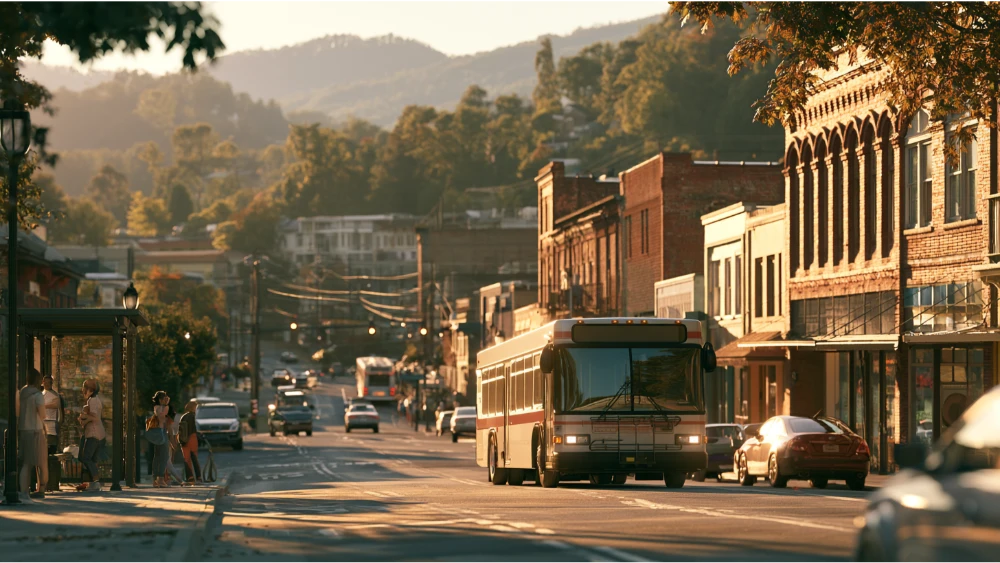
An 18.2-minute mean commute is short for a metro this size. Asheville Rides Transit runs 18 routes from the downtown station at a $1 standard one-way fare, generally 5:30 a.m. to 10:30 p.m. Monday through Saturday and 8:30 a.m. to 6:30 p.m. Sundays and holidays, with variation by route. I-26 and I-40 carry regional traffic.
Car-light living works on foot in a few central corridors, not metro-wide. If you’ve heard about free trolley rides downtown, confirm what’s actually running before you plan around it, because seasonal services change. Test your home-to-work route at the hour you’d drive it instead of trusting a citywide walkability score. Asheville Regional Airport handled 2,240,877 passengers in 2025 with six airlines and 27 nonstop destinations.
Weather, Flood Risk, and Hurricane Helene Recovery
January, the heart of winter, has a normal high of 48.9°F; July’s is 85.3°F, with 10.3 inches of normal annual snowfall and about 130.5 days of measurable precipitation (NOAA 1991–2020). Summer runs warmer than the mountain postcards suggest. The beautiful fall color is a real draw and brings real traffic.
As of September 25, 2026, the city’s Public Works Department was managing Helene recovery at nearly 200 sites: bridges, culverts, roads, sidewalks, landslides and stormwater. Most parks and greenways have reopened fully or partially, though the hardest-hit riverfront properties and part of the French Broad River Greenway remain closed. A unified riverfront parks design was introduced in June 2026.
Complete this checklist before you sign a lease:
- Ask whether the unit or its access road flooded.
- Ask what was replaced: HVAC, electrical, lower-level finishes.
- Verify exposure on the North Carolina Flood Risk Information System and FEMA maps.
- Check the repair status and safety of nearby roads and bridges.
- Get a renters insurance quote and ask about flood exclusions.
Things to Do in Asheville: Downtown Asheville, Water Sports, and the Outdoors
Pack Square and the surrounding downtown area hold the galleries, museums, restaurants and independent shops you’ll use on a Saturday, and the events calendar stays full with festivals celebrating music, food and craft brewing. The River Arts District holds roughly 150 studios where artists kept working through recovery, and locals are proud of how that corner of the city came back. Live music runs most nights.
Outdoors, the Blue Ridge Parkway is built for 45 mph or less, so check the National Park Service live road-status page first. The greenway network is good for walking and biking, and the city is surrounded by national forest trails, with the North Carolina Arboretum close by. On the French Broad, water sports like paddling, tubing and kayaking are back in play, though you should confirm access points and outfitter status after Helene. Biltmore Village and the Omni Grove Park Inn round out the list.
Should You Rent First or Buy in Asheville?
Rent first if you’re still learning the terrain, the traffic patterns, the flood corridors and exactly where you want to live. Buy once you’ve evaluated insurance, drainage, slope, access roads, repair history and a commute you’ve driven yourself. If buying is of real interest, explore a few corridors in person, then pressure-test the math with our Rent vs. Buy Calculator and Mortgage Calculator.
KT Rents is a full-service, broker-owned property management company operating nationwide since 2009, with 683 units across 34 states and $187M in managed assets as of early 2025, and a reported 98% occupancy rate. If you’re moving here and keeping homes behind you, we handle tenant placement, tenant screening, rent collection, property maintenance, rental permits, 1099s, property inspections and court evictions without the owner lifting a finger, for roughly the price of a cup of coffee and a donut per day. Call (800) 716-4950, text (608) 207-0657, or email info@ktrents.com. Renters, browse our nationwide marketplace and find your perfect home. Your Rental. Your Way.
Frequently Asked Questions
What is the best area to live in Asheville NC?
Pick a neighborhood by criteria, not ranking. Downtown and the South Slope for walkability, West Asheville for bungalows on Haywood Road, North Asheville and Montford for historic homes, Biltmore Park for newer planned housing. Then check terrain, transit and the flood map for that exact address.
What is the average cost of living in Asheville NC?
Median household income is $71,102 and median gross rent $1,402 (ACS 2020–2024), with a HUD two-bedroom FMR of $1,866. North Carolina’s 2026 income tax rate is 3.99% and Buncombe’s combined sales tax is 7.00%. A commonly cited local estimate puts the income needed to maintain living standards near $78,363.
Is the population growing?
Growth rankings shift with every data release and depend on how boundaries are drawn, so we won’t name a leader without a dated source. Asheville’s city population was estimated at 93,523 in July 2025, roughly 1.3% below the 2020 base.
What is the downside of moving to Asheville North Carolina?
Housing costs measured against a $29.08 mean hourly wage (May 2025), car dependence outside central corridors, tourism traffic, and Helene recovery that still demands address-level flood research. One practical gotcha: new residents who drive generally have 60 days to get a North Carolina license and register their vehicles.