

Cary, North Carolina
Homes for rent and for sale — search the map or open the full city SEO catch-all page.
Cary, North Carolina
Moving to Cary, North Carolina puts you close to Research Triangle Park jobs, 2,690 acres of parks, and over 100 miles of greenways, but housing costs are real: median home value is $580,200 and median gross rent runs $1,738. The town spans three counties, so your exact address determines your school district, tax rate, and services. Renting first is a smart way to test the commute and neighborhood before buying.
Moving to Cary, North Carolina
Moving to Cary, North Carolina makes sense if you want Research Triangle jobs, serious park and greenway space, and established public services. The tradeoffs are real. Housing costs more than much of North Carolina, school assignment depends on your exact address, and growth has pressured the roads. This guide is for renters and relocating households deciding whether Cary is the right place to live.
Cary is not one uniform suburb. It spans Wake, Chatham, and Durham counties, so taxes, services, and school district all depend on the address. Where you live inside town matters. And median rent from Census data measures something different than the advertised rent on a listing page.
Why Are So Many People Moving to Cary, North Carolina?
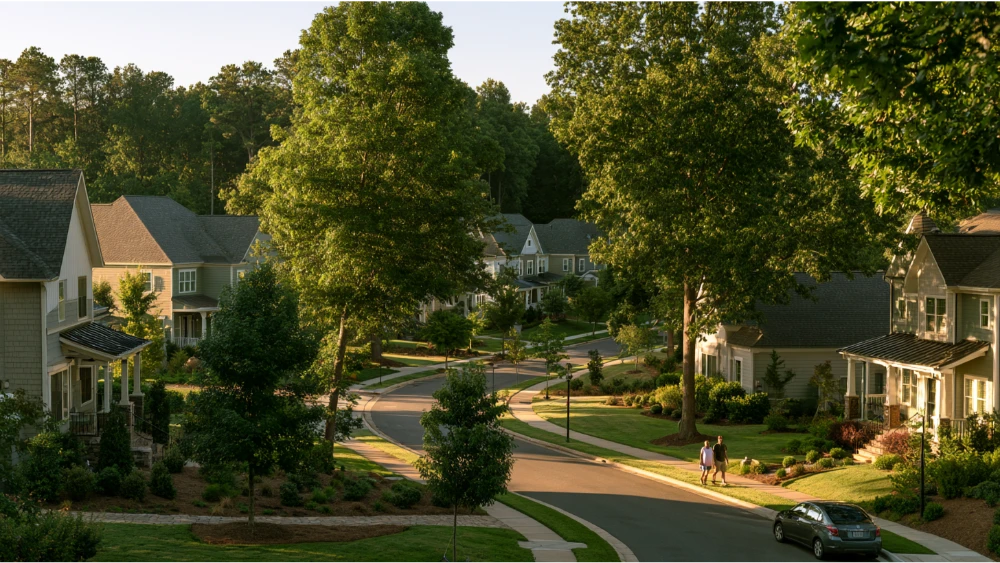
Cary sits between Raleigh, Durham, and Chapel Hill, roughly 20 miles from each, with quick access to Research Triangle Park and RDU. The Census Bureau estimated the population at 183,582 as of July 1, 2025, about 5% above the April 2020 base. The town’s own planning estimate was 192,000 as of January 1, 2026, higher because it uses a later date and local permit activity. Don’t blend the two. Many residents moved here from larger, pricier metros, and 69.4% of residents 25 and older hold a bachelor’s degree or higher (2024 ACS).
Moving to Cary North Carolina: What Does It Cost to Live Here?
| Metric | Figure | Date | What it measures |
|---|---|---|---|
| Median gross rent | $1,738 | 2020-2024 Census | Occupied rentals plus tenant-paid utilities |
| Average advertised rent | ~$2,100 | Oct 1, 2026 | Listed units only, volatile |
| Median home value | $580,200 | 2020-2024 Census | Owner-occupied homes |
| Median household income | $135,132 | 2024 ACS | All households |
The gap between $1,738 and $2,100 isn’t a price jump. One looks backward across every occupied rental, the other at what’s listed right now. Budget for HOA dues (the stock is roughly 73% single-family, 27% multi-unit), tolls on NC-540, and North Carolina’s 3.99% flat income tax for tax years after 2025. Cary prices above Charlotte and most of the state, so if you moved from Charlotte or a smaller town, statewide averages will mislead you. The town uses the 30%-of-income guideline and found 35% of Cary renters above that line. Run your numbers through our Cost of Living Calculator and Rent Calculator before making any decision.
Which Areas of Cary Should You Compare?
- Downtown and central: older homes, infill apartments and townhouses, the Amtrak depot, and the most walkable place to live in town. Smaller lots.
- West Cary: planned communities like Amberly, Cary Park, and Carpenter, with newer builds near NC-540. Tolls add up.
- North Cary, Preston, Weston: established subdivisions and office parks, fast routes to RTP, RDU, and I-40 if you’re working in the Park. Heavy peak traffic.
- South and southeast: Lochmere, Kildaire, Regency, and MacGregor near the hospital, Hemlock Bluffs, and Koka Booth. Farther from RTP.
- East Cary, Fenton, South Hills: mixed-use redevelopment, apartments, easy Raleigh access. Active construction.
Verify county, HOA rules, pet policy, and school assignment at the exact address.
Jobs, Commutes, and Getting Around
Cary added 1,275 jobs in 2025, and the Raleigh-Cary metro unemployment rate was 3.1% in August 2026 (metro, not municipal). The mix runs wider than tech: professional and scientific services, healthcare, education, finance and insurance, life sciences, advanced manufacturing, and retail. Plenty of people live and work inside Cary. Others commute to RTP, Raleigh, or Durham, and more are working remotely every year. Mean commute was 22.5 minutes (2020-2024 Census), an average, not your trip. Driving means I-40, NC-55, US-1, Cary Parkway, and tolled NC-540. GoCary fixed routes are fare-free in 2026 (the Downtown Loop was suspended July 9, 2026, so recheck it). Cary Depot connects by Amtrak to Raleigh, Durham, Greensboro, and Charlotte. RDU lists 90+ nonstop destinations. Most routines still need a car, so test-drive your commute at your real travel time.
Schools, Hospitals, and Things to Do

Schools. Most Cary addresses fall in the Wake County Public School System, which lists 204 schools for 2026-27 and reported a 91.3% four-year graduation rate in 2025-26. Some addresses belong to Chatham or Durham districts. Assignment is by exact address, schools can be capped with overflow placement, and calendars run traditional or year-round (at least 177 attendance days). Run the address through the district lookup before signing, and read the full North Carolina report card, not just the letter grade.
Healthcare. WakeMed Cary Hospital is the town’s only full-service hospital: 208 licensed acute-care beds, a 24/7 emergency department, and Level III Trauma Center designation, with urgent care, specialty practices, and larger Triangle campuses nearby.
Things to do. As of September 1, 2026 the town reported 35 parks across 2,690 acres and more than 100 miles of greenway (older guides still cite 80). Add Downtown Cary Park, Bond Park, Hemlock Bluffs, Koka Booth Amphitheatre, Cary Arts Center, The Cary Theater, Page-Walker, Cary Tennis Park, WakeMed Soccer Park, and the USA Baseball complex. Weekend entertainment is one reason households that moved here tend to stay.
Weather and Your Cross Country Move Checklist
Four real seasons. Mid-July normals at RDU run near 90°F/70°F with humidity; early January sits around 52°F/32°F (1991-2020 NOAA normals). Winters are mild but not snow-free, and tropical remnants reach the Triangle. If you moved from a drier climate, the summer humidity is the adjustment. A cross country move means packing for both extremes.
- Confirm which county your address sits in.
- Run the school address lookup.
- Set up utilities before move-in day.
- Line up renter’s insurance.
- Handle your North Carolina license and registration within 60 days.
- Photograph move-in condition once you’ve moved, then register to vote.
Should You Rent First or Buy?
Renting first lets you test the commute, the area, and the real school assignment before committing to a $580,200-median market. Start with our Rent vs. Buy Calculator, Mortgage Calculator, and Rent Calculator, then browse rentals and homes for sale on our nationwide marketplace or submit a rental application. KT Rents is a full-service, broker-owned property management company with 16+ years of experience across the U.S. since 2009: tenant placement, tenant screening, rent collection, property inspections, and court evictions handled for you. As of early 2025 that’s 683 units in 34 states and $187M in assets under management, with a reported 98% occupancy rate. Own Triangle-area property? GET STARTED WITH US TODAY. Call (800) 716-4950, text (608) 207-0657, or email info@ktrents.com. We respond within 24 hours.
Frequently Asked Questions
Is Cary, North Carolina a good place to live?
For most households that moved here, yes. You get Triangle job access, parks and greenways, and established public services. The honest tradeoffs are housing cost and growth-related traffic.
How much money do you need to live in Cary?
Use the 30%-of-income guideline against real figures: $1,738 median gross rent (2020-2024 Census) or roughly $2,100 average advertised rent (October 1, 2026), plus North Carolina’s 3.99% flat income tax. Cary runs above Charlotte, so run your own numbers through our Cost of Living Calculator.
Is Cary conservative or liberal?
Cary has a politically mixed, highly educated population. For data rather than characterizations, check county and North Carolina State Board of Elections registration and results records.
What is the biggest risk of living in North Carolina?
Weather exposure: summer heat and humidity, occasional winter storms, and tropical remnants. Housing cost is the close second. Check flood zone status and insurance requirements for the place you plan to live.