

Grand Forks, North Dakota
Homes for rent and for sale — search the map or open the full city SEO catch-all page.
Grand Forks, North Dakota
Moving to Grand Forks, North Dakota means settling into a city of about 60,365 people where prices run roughly 13.3% below the national level, metro unemployment sits at a preliminary 2.8%, and the average commute is just 14.8 minutes. The rental vacancy rate of 3.55% in Q4 2025 means inventory is tight, so start your housing search earlier than you think you need to. Winters are serious, with a January normal low of minus 3.1°F and 48.4 inches of annual snowfall.
Moving to Grand Forks, North Dakota
Grand Forks, ND is a mid-sized city of about 60,365 people (Census estimate, July 2025) where overall prices run roughly 13.3% below the national price level (BEA 2024 metro Regional Price Parity), metro unemployment was a preliminary 2.8% in August 2026 (BLS), and the average commute takes 14.8 minutes. The tradeoffs are real: deep winters and a rental market tighter than the city’s affordability reputation suggests. Whether you’re relocating for the university, the health system, the Air Force base, or remote work, here’s the numbers-first picture before you sign anything. We’re KT Rents, a broker-owned, full-service property management company and rental marketplace operating nationwide since 2009.
Moving to Grand Forks North Dakota: is it a good place to live?
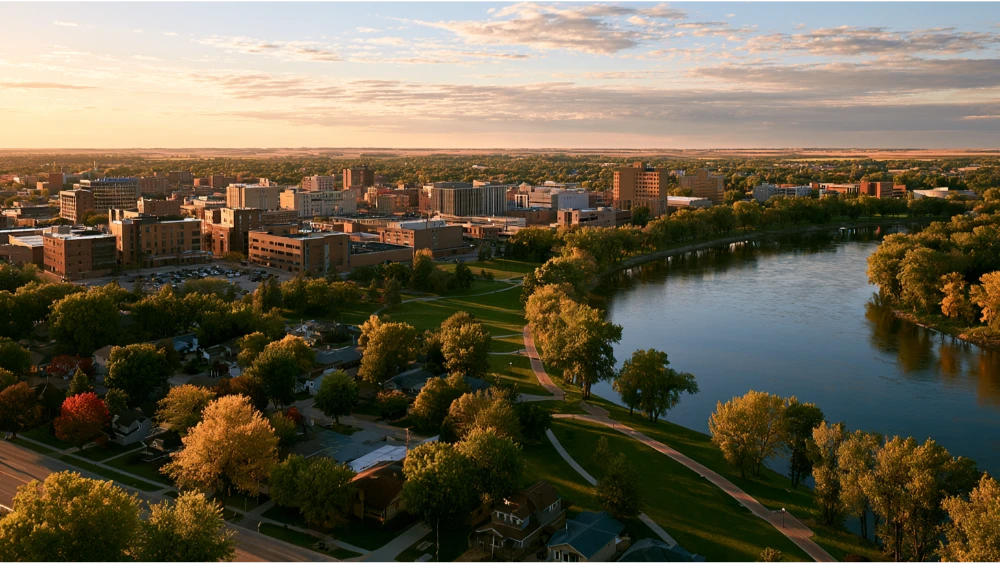
Three good reasons people move to Grand Forks, ND
- Affordability is real. The 2024 Regional Price Parity for the metro was 86.663, meaning prices sat about 13.3% below the national level. Median household income was $63,627 (Census, 2020-2024, in 2024 dollars).
- The commute is short. A 14.8-minute mean travel time to work changes how a weekday feels.
- The job base is diverse. Education, healthcare, government, aviation, manufacturing and the military all anchor the local economy, which spreads your career risk across more than one industry.
Three tradeoffs to plan for
- Winter is not a metaphor here. Normal annual snowfall is 48.4 inches and the January normal low is minus 3.1°F (NOAA 1991-2020 normals).
- No Sunday bus service. Cities Area Transit doesn’t run fixed routes on Sundays.
- Rentals are tighter than you’d expect. The local apartment association’s Q4 2025 survey put vacancy at 3.55%. A vacancy rate is simply the share of rental units sitting empty and available at a given moment. The city’s housing consultant describes 5% to 10% as a healthy range, so Grand Forks, ND currently sits below that.
Grand Forks, ND at a glance
- Population: 60,365 (July 2025 estimate), up about 2% from the April 2020 base
- Households: roughly 26,171, averaging 2.09 people
- Owner-occupied housing rate: 46.4%
- Adults 25+ with a bachelor’s degree or higher: about 40%; high school completion 95.7%
- Mean commute: 14.8 minutes
- County seat of Grand Forks County, and the retail and medical hub for smaller communities across the region
- University of North Dakota fall 2026 enrollment: 15,908, a record for the second straight year
One thing to keep straight as you read relocation content: Census QuickFacts numbers cover the city limits, while BLS employment and BEA price data cover the Grand Forks ND-MN metropolitan area, which includes East Grand Forks, Minnesota and surrounding territory. We’ll label which is which. If you’re comparison shopping within the state, Fargo is the larger metro roughly 75 miles south.
What does it cost to live in Grand Forks, ND?
Regional Price Parity is the cleanest broad measure available. It measures the price of a comparable basket of goods, services and housing across metro areas, with 100 representing the national average. Grand Forks came in at 86.663 for 2024. In plain terms, a dollar stretches about 13% further here, so a bigger share of your paycheck stays yours.
Now the other side of that math. Affordability is a two-sided number. The metro’s mean hourly wage across all occupations was $29.80 in May 2025, against $33.54 nationwide. Lower prices tend to come with lower nominal pay, so the question isn’t “is it cheap” but “does my specific income clear my specific costs here.” Run your own figures through our Cost of Living Calculator before you commit to a number in your head.
Here is the cost picture in one place:
| Cost measure | Figure | Source and date |
|---|---|---|
| Overall price level | 86.663 RPP, about 13.3% below national | BEA, 2024 metro |
| Median household income | $63,627 | Census, 2020-2024, 2024 dollars |
| Mean hourly wage, all occupations | $29.80 metro vs. $33.54 national | BLS, May 2025 |
| Median gross rent | $980 | Census, 2020-2024 five-year |
| Median owner-occupied home value | $249,900 | Census, 2020-2024 |
| Combined sales tax | 7.25% general; 7.5% on prepared food, on-sale alcohol, qualifying lodging | 5% state plus 2.25% city |
| Individual income tax rates | 0%, 1.95%, 2.5% by income and filing status | North Dakota, tax year 2025 |
| Transit fare | $2 one-way; $40 for a 31-day pass | Cities Area Transit |
Sales and income taxes in Grand Forks, ND
North Dakota’s state sales tax is 5% and Grand Forks adds 2.25%, for a general combined rate of 7.25%. Prepared food, on-sale alcohol and qualifying lodging generally run 7.5% because of an additional local quarter-percent. For tax year 2025, North Dakota’s individual income tax brackets used rates of 0%, 1.95% and 2.5% depending on income and filing status, among the most taxpayer-friendly in the country. Verify the current year’s brackets with the state tax department, ask whether any special assessments are attached to a property you’re considering, and look into North Dakota’s property tax credit programs. Your bill comes through Grand Forks County.
Budget lines people forget
- A heating season that runs from roughly October into April, not just a cold January
- Heat lost through older windows and doors, which shows up fast on a January bill
- Snow removal, whether that’s a service contract, a snowblower, or your own back
- Winter tires and a battery that can actually start below zero
- A DIY move across Plains distances: truck rental plus fuel adds up fast, and hiring help sometimes prices out closer than people assume
What is the rental market like in Grand Forks, ND?
You’ll see $980 cited as the median rent. That’s the Census median gross rent from the 2020-2024 five-year estimate, which includes utilities paid by the renter and averages five years of leases. It is not a quote on a unit available today. Treat it as a floor-level reference point, then check current asking rents yourself.
Availability is the part most relocation guides skip. City materials reported a 3.5% private-sector apartment vacancy rate in Q1 2025 across 6,165 surveyed units. Other 2025 studies cited by the city produced estimates ranging from under 1% to 1.3%. The local apartment association reported 3.19% in Q3 2025 and 3.55% across 7,662 private units in Q4 2025. All of those sit below the 5% to 10% range the city’s consultant calls healthy.
What that means for you: start looking earlier than you think you need to, stay flexible on lease start dates, and don’t assume a below-average price level guarantees easy inventory. You’ll find apartments, townhouses, condos, duplexes and single-family rentals across Grand Forks, ND communities, and with only 46.4% of housing owner-occupied, renting is a large and normal share of the market here.
Questions to ask before you sign a Grand Forks, ND lease
- Which utilities are included, and what did heat cost in this unit last winter?
- Who clears the driveway, steps and sidewalk after a snowfall, and is that in writing?
- Is there a garage, a block-heater outlet, or any indoor parking? A garage is a nice-to-have in June and close to essential in January.
- Is the unit pet-friendly, and what are the breed, weight and deposit terms?
- How do you submit maintenance issues, and what’s the typical response time?
That last one separates a managed property from a landlord who answers texts when convenient. Full service means tenant placement, tenant screening, rent collection, maintenance requests and property inspections all run through one system. It’s what we do nationwide, and KT takes care of each unit as if it were our own.
Should you rent first or buy a home in Grand Forks, ND?
The Census figure of $249,900 is the median value of owner-occupied housing units for 2020-2024. It is not a current median sale price. For that, you need a date-stamped pull from the current market.
A good rule of thumb: rent first if you’ll be here under three years, if your job is probationary or assignment-based, if you haven’t yet lived through a Red River Valley winter, or if buying would drain the cash you’d need for a furnace repair in February. Buy now if your timeline is long, your income is stable, and you’ve got reserves beyond the down payment. Check the Grand Forks County record for a property’s tax history before you make an offer, and run our Rent vs. Buy Calculator and Mortgage Calculator to put actual numbers on the choice.
Grand Forks, ND neighborhoods and communities: how to compare them
We’re not going to rank areas as “best” or label who belongs where. That’s both unhelpful and contrary to Fair Housing principles. Instead, compare on criteria you can verify for a specific address: housing age, parking, winter maintenance and nearby parks. Comparing by ZIP code alone can mislead, since school boundaries, city services and flood zones don’t follow postal lines, and addresses just outside the city limits sit in Grand Forks County townships with different services.
| Area | Typical housing | Commute anchors | Winter and parking notes |
|---|---|---|---|
| Downtown and near-south | Older homes, upper-floor apartments, lofts | Walk to downtown jobs; short drive to UND | Street parking, snow-emergency routes matter |
| UND and near-campus | Early-to-mid-century homes, student-oriented rentals | Campus, medical school | Mature trees, smaller lots, detached or no garage common |
| South Grand Forks | Newer single-family, townhouses, newer apartments | Retail corridors, hospital | Attached garages more common |
| 32nd/42nd Street and Alerus corridor | Newer construction, apartment complexes | Shopping, event venues | Larger lots, private snow removal typical |
| North end and Riverside | Established homes, varied eras | Downtown, Greenway access | Riverside Park and trail access nearby |
| Near-base and western approaches | Mixed; some newer builds | Grand Forks Air Force Base, airport | Open-country driving in blowing snow |
| Ben Franklin area | Established single-family | Central city access; Ben Franklin Elementary is located here | Older streets, verify driveway and alley access |
Grand Forks vs. East Grand Forks: one metro, two states
The two communities share the Red River, the airport and most of daily life, but East Grand Forks is in Minnesota. Different state income tax, different vehicle registration and licensing rules, a different school district, different city services. Know which side of the river an address is on before you sign.
Jobs and employment in the Grand Forks ND metro
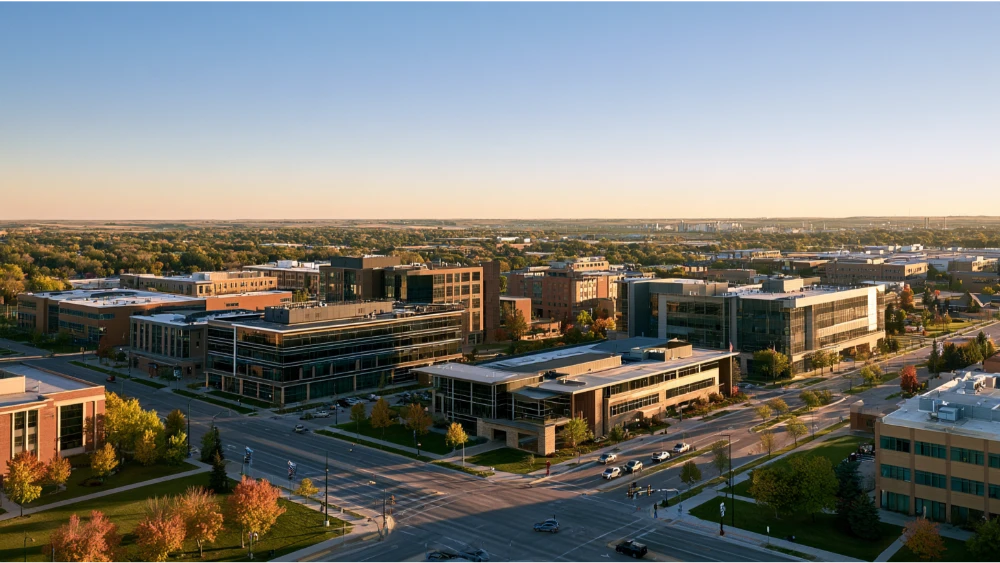
These are Grand Forks ND-MN metro figures. Unemployment was a preliminary 2.8% in August 2026, with roughly 55,000 total nonfarm jobs, up 1.1% year over year.
| Sector (Aug 2026) | Jobs |
|---|---|
| Government | 12,000 |
| Trade, transportation and utilities | 10,900 |
| Education and health services | 9,600 |
| Leisure and hospitality | 5,900 |
| Manufacturing | 4,800 |
| Professional and business services | 4,000 |
Government holds the largest share of metro employment, with trade, transportation and utilities close behind. The mean metro wage was $29.80 an hour in May 2025, with management, healthcare practitioners, and architecture and engineering occupations above that line. The University of North Dakota and Altru Health System are the region’s largest employers, and that spread across education, healthcare, government and industry is a genuine advantage if your career needs a fallback.
The aerospace and unmanned systems cluster
UND’s aviation program draws students from around the world, and Grand Forks Air Force Base, Grand Sky and related private activity have built a meaningful unmanned-systems presence here. The regional economic development corporation maintains a leading-employer list, last updated September 2026, and that’s the right place to find out who’s actually hiring before you move.
Schools and education in Grand Forks, ND
Grand Forks Public School District 1 reported 7,822 students across 18 schools serving communities throughout the city in 2024-2025 federal NCES data. The district operates elementary, middle and high schools plus alternative programs and Head Start, and it publishes an attendance-area search and boundary maps.
Use that tool on the exact street address to determine the assigned school before you sign a lease or purchase agreement. If you’re moving with kids, do it first. Attendance boundaries do not follow neighborhood nicknames, and two houses on the same block can occasionally feed different schools.
Career and technical education and higher ed
The Career Impact Academy expands CTE pathways including advanced manufacturing, aerospace and unmanned systems, construction, computer science, culinary arts, engineering and robotics, health sciences, precision technologies, automotive services and welding. UND enrolled a record 15,908 students in fall 2026 and also serves adult and continuing education.
Hospitals and healthcare access
The city’s new main hospital opened January 19, 2025 with 226 licensed beds, a 16-bed observation unit, 12 operating rooms and four catheterization labs. The health system runs a Level II Trauma Center, a 24/7 emergency department, ambulance service, fixed-wing air ambulance support and a certified Primary Stroke Center.
That depth matters more than it would in a dense metro. When the next larger city is more than an hour away and the road might be closed for blowing snow, having trauma and stroke care in town is a practical consideration, not a brochure line. For plenty of households, that access is the single biggest quality-of-life factor in the move.
What are Grand Forks, ND winters really like?
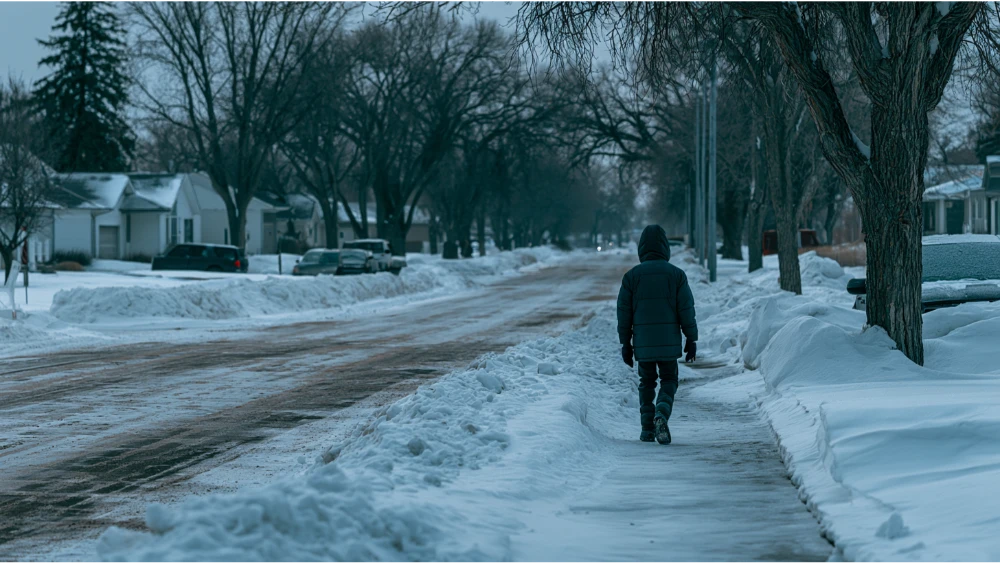
NOAA 1991-2020 normals, not adjectives:
- January normal high 15.8°F, normal low minus 3.1°F
- July normal high 80.7°F, normal low 57.0°F
- Annual mean temperature 39.8°F
- Normal annual snowfall 48.4 inches, with December taking the largest share at 12.3 inches and January at 9.9 inches
The practical consequences: visibility can be lost in minutes when wind lifts loose snow across open ground, commutes stretch, accidents climb when road conditions are poor, and flights out of the local airport get disrupted during storms. A January here is a world away from a mild coastal one. None of it is unmanageable. It just takes planning.
Winter-readiness checklist for new residents
- Winter tires and a battery you’ve actually had tested
- Block heater, or indoor and garage parking if you can get it
- In-car emergency kit: blankets, food, phone charger, shovel, sand or kitty litter
- Layered outerwear and boots rated for real cold, not fashion boots
- Sign up for city snow-emergency alerts and school-closing notifications
- Confirm in writing who shovels at your rental
- Budget for heating-season utility bills before the first one arrives
Getting around Grand Forks, ND: do you need a car?
The 14.8-minute mean commute is short even by small-city standards. Cities Area Transit runs Monday through Friday from 6 a.m. to 10 p.m. and Saturday from 8 a.m. to 10 p.m., with no Sunday fixed-route service. Adult one-way fare is $2 and a 31-day pass is $40.
Grand Forks International Airport sits about 4.8 miles west, with hub service to Minneapolis plus nonstop leisure routes to Las Vegas and Phoenix/Mesa and seasonal Orlando/Sanford. Air routes change often, so check current schedules directly. Amtrak’s Empire Builder stops here on the Chicago to Pacific Northwest route, at overnight or early-morning times.
Who can realistically live car-free here?
Only a small share of households pull it off. It works if your home, job, groceries and daily errands all sit along a CAT route or near campus and downtown. For most people, the Sunday service gap and winter walking conditions settle the question. Warm-season cycling is a different story, with Greenway trails and bike-friendly city routes making a real dent in April through October commuting.
Things to do in Grand Forks, ND year-round
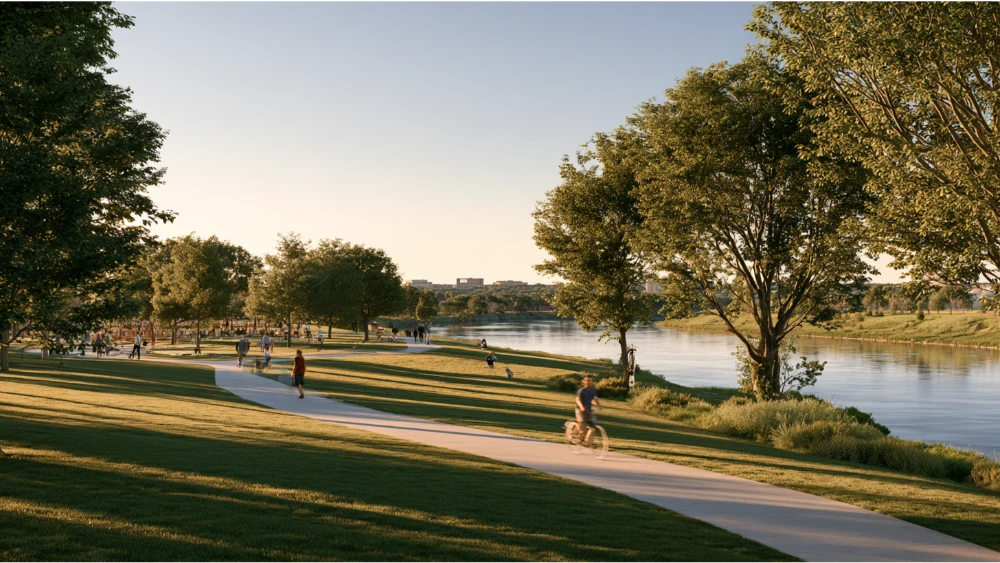
Start with the Greenway: roughly 2,200 acres along the Red and Red Lake rivers with about 20 miles of trails, built into the city’s flood-protection system. Walking, cycling, cross-country skiing, sledding, skating and fishing all happen in that corridor, and trail access from most parts of the city is excellent. Sertoma Park and its Japanese Garden, Riverside Park and Lincoln Park anchor a deep bench of neighborhood parks, and summer fishing on the Red is minutes from most addresses.
Hockey, arts, and downtown
UND hockey anchors the local winter calendar at an arena seating roughly 11,568, and the culture around it is genuine. The city’s major arena and event center books concerts and touring events. The North Dakota Museum of Art, the Empire Arts Center and community theatre cover the arts side, and downtown offers dining, independent shops and public art within a walkable, pedestrian-friendly few blocks. It’s a nice counterweight to the retail corridor on the south side.
Annual events worth planning around
Farmers markets through the warm months, ArtFest, the Downtown Street Fair, and a slate of winter events that pull communities together and give people a good reason to leave the house in January.
Public safety and flood protection in Grand Forks, ND
Grand Forks Police reported 1,598 index offenses in 2024, down 5.6% from 1,693 in 2023 and 9.2% below the 10-year average. Within that, violent crime ran above its 10-year average while property crime ran below. Calls for service totaled 59,047, up 11.2%. Pull the department’s most recent annual report rather than trusting a single adjective from a relocation page. That’s a good habit in any city you’re considering.
On flooding: the post-1997 protection system and the Greenway were built together for exactly this reason. Still, check FEMA flood-zone status and insurance requirements for the specific address before you lease or buy, since those issues price by zone, not by neighborhood reputation.
Your first 30 days after moving to Grand Forks, ND
- Transfer your driver’s license. A noncommercial out-of-state license is generally usable for 60 days after you become a North Dakota resident, and the state generally treats 90 consecutive days as establishing residency for licensing, with exceptions for nonresident students, tourists and nonresident military.
- Register your vehicle once residency is established or you accept employment, whichever comes first.
- Set up electric, gas, water and internet, and ask each provider about budget billing.
- Register students using the district’s address-based boundary tool.
- Buy a CAT pass if you’ll ride regularly.
- Stock winter supplies before December, not during the first storm.
- Update auto and renters insurance, voter registration and your mailing address.
Frequently Asked Questions
Is Grand Forks, ND a good place to live?
For a lot of households, yes: prices run roughly 13.3% below the national level, the commute averages under 15 minutes, metro unemployment was 2.8% in August 2026, and you get university and major hospital access in a city of 60,000. It’s a harder fit if you want mild weather year-round, Sunday transit, or rentals you can find in a weekend.
Why are people moving out of North Dakota?
The reasons most commonly cited are climate, distance from large metros and limited nonstop air service. The picture isn’t uniform statewide, though. Grand Forks itself grew about 2% between April 2020 and July 2025 per Census estimates.
Is Grand Forks, ND Democrat or Republican?
North Dakota votes reliably Republican in recent statewide and presidential elections, while the Grand Forks city area is more mixed than the rest of Grand Forks County. City offices are nonpartisan. Check Grand Forks County and state election results for current figures.
Is moving to North Dakota a good idea?
It depends on your fit. Low individual income tax rates, below-national price levels and a diverse regional economy sit on one side. Winter severity and distance from major metros sit on the other, and only you can price the quality-of-life side of that. Run your own numbers before deciding.
Plan your move to Grand Forks, ND with the right numbers
Start with our Cost of Living Calculator, then compare renting against owning with the Rent vs. Buy Calculator and Mortgage Calculator. When you’re ready to find a place, browse rentals through our nationwide marketplace, including pet-friendly options. KT Rents has been a full-service, broker-owned property management company since 2009, operating across the U.S., and we’re glad to share what we know. Call (800) 716-4950, text (608) 207-0657, or email info@ktrents.com with your questions or comments. We respond within 24 hours.