

Kansas City, Missouri
Homes for rent and for sale — search the map or open the full city SEO catch-all page.
Kansas City, Missouri
Moving to Kansas City, Missouri means a cost-of-living index of 86.6 against a U.S. baseline of 100, with housing and transportation costs well below the national average. The metro offers a 21.7-minute mean commute, a 3.9% unemployment rate, and 222 parks. Success depends on choosing the right neighborhood, since rent, school assignment, and transit access shift dramatically across the city’s 314.7 square miles.
Moving to Kansas City, Missouri

Kansas City, Missouri gives you housing and transportation costs below the national average, a job market spread across logistics, healthcare and professional services, a mean commute of 21.7 minutes, and more than 220 city parks. The catch: the city covers 314.7 square miles and holds roughly 521,220 residents as of July 1, 2025 (Census), so rent, taxes, school assignment and transit access change dramatically between neighborhoods.
This guide is for renters, relocating households and remote workers comparing markets. You’ll get dated numbers, a neighborhood framework that works on any listing, and a first-30-days checklist. KT Rents is a full-service, broker-owned property management company operating nationwide since 2009.
Moving to Kansas City, Missouri: The Quick Answer
If your income is portable or you work in healthcare, logistics or professional services, Kansas City delivers a lower cost of living compared to most large U.S. metros. The tradeoff is car dependence outside a narrow streetcar corridor and real variation between neighborhoods, sometimes block to block. Moving to Kansas City, Missouri works best when you treat the address as the decision, not the city.
| Figure | Number | Geography / Date |
|---|---|---|
| Cost-of-living index | 86.6 (U.S. = 100) | Metro, Q2 2026 (MERIC) |
| Median gross rent | $1,238/month | City, 2020-2024 (Census) |
| Median household income | $69,166 | City, 2020-2024 (Census) |
| Unemployment rate | 3.9%, preliminary | Metro, Aug. 2026 (BLS) |
| Mean commute | 21.7 minutes | City, 2020-2024 (Census) |
Kansas City, Missouri vs. the KC Metro: Why the State Line Matters
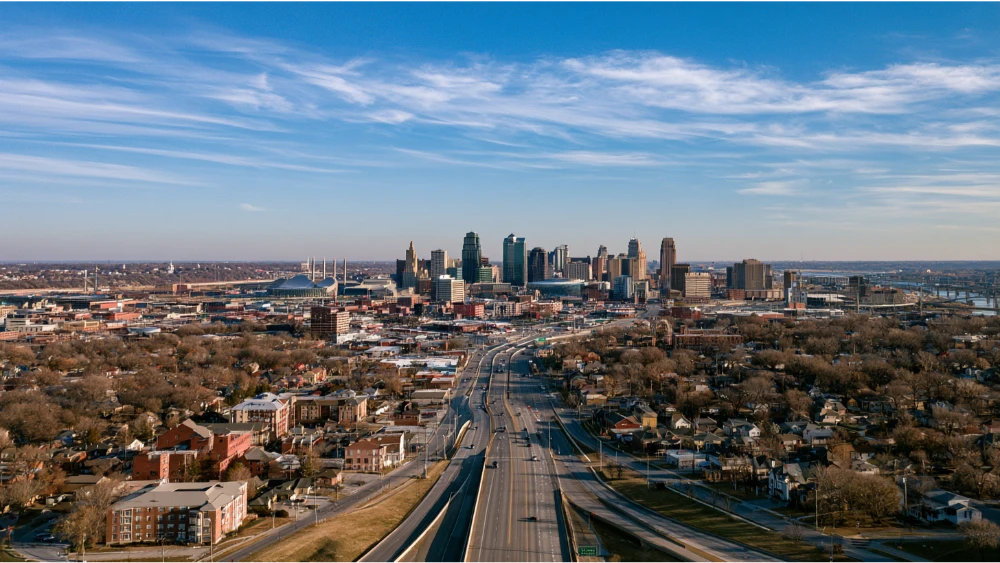
Three geographies get called “Kansas City,” and mixing them up will wreck your budget. Kansas City, Missouri (KCMO) is the city proper, and across Missouri, Kansas City is the largest city by population. Kansas City, Kansas sits across the state line in Wyandotte County. The bi-state KC metro wraps both, plus Overland Park on the Kansas side and Lee’s Summit on the Missouri side.
Most published “Kansas City” statistics, including cost-of-living and employment data, are metro-wide. Rent, the city earnings tax, trash service and school assignment are address-specific. Which side of the line you live on changes all four.
Cost of Living in Kansas City: What’s Actually Cheaper?
The Kansas City MO-KS metro posted a cost-of-living index of 86.6 in Q2 2026 against a national baseline of 100, per MERIC. The savings aren’t evenly spread.
| Category | Index (U.S. = 100) |
|---|---|
| Housing | 82.9 |
| Transportation | 80.1 |
| Healthcare | 89.3 |
| Groceries | 96.7 |
| Utilities | 98.1 |
Housing and transportation do nearly all the work. The lower cost shows up in your rent and your gas tank, not your grocery cart, so don’t budget as though every line item drops 13%. That index is metro-wide, while the rent and income figures here are city proper.
Kansas City Housing Market: How Much Is Rent?
Two median rent numbers circulate, and they measure different things. Census median gross rent for Kansas City, Missouri was $1,238 across 2020-2024. Current listing data showed an average asking rent of $1,420 across all bedrooms and property types on September 26, 2026, based on 1,801 available rentals, down $3 month over month and up $25 year over year.
The housing market’s reputation for affordable housing is mostly earned, but neither number replaces checking the actual property. Single-family homes, townhouses, condominiums and apartments price very differently inside one ZIP code. Budget moving costs separately, then run your numbers through the KT Rents Rent Calculator and Cost of Living Calculator before you book a tour.
Should You Rent or Buy After Moving to Kansas City?
Lease first. A short-term or long-term rental lets you test a commute, a school district and a block before committing six figures. Census put the median owner-occupied home value at $242,900 (2020-2024) while one home-value index placed the typical value at $253,549 in August 2026, up 1.7% year over year. Median monthly owner costs with a mortgage: $1,709. Our Rent vs. Buy Calculator and Mortgage Calculator do the comparison math.
The Kansas City Job Market and Job Opportunities
Metro unemployment was 3.9% in August 2026 (BLS, preliminary, not seasonally adjusted), with roughly 1.178 million nonfarm jobs, up 0.7% year over year. The mean wage across all occupations was $31.99 per hour in May 2025. Missouri’s minimum wage is $15 per hour in 2026.
Which industries are hiring?
The biggest sectors by employment are trade, transportation and utilities (230,500 jobs), education and health services (185,400), professional and business services (185,100), government (148,800) and manufacturing (91,300). Major employers cluster in hospital systems, freight and distribution, professional services and health-information technology, and the region’s role as a national transportation hub keeps that first sector large.
A growing job market plus below-average housing costs keeps pulling in young professionals, growing households and retirees from pricier metros. If your income is portable, the math is simple: short commutes go a long way when your salary is set somewhere else.
Taxes New Residents Need to Know
- 1% earnings and profits tax on residents regardless of where they work, and on nonresidents for work performed inside the city. It has historically required periodic voter renewal, so confirm current status.
- 4.7% Missouri top individual income tax rate for 2026 (Missouri DOR).
- Sales and property tax varies by county and special taxing district. Improvement and transportation development districts can change the total charged at one address versus another nearby.
Kansas City Neighborhoods: Great Places to Live by Lifestyle and Commute
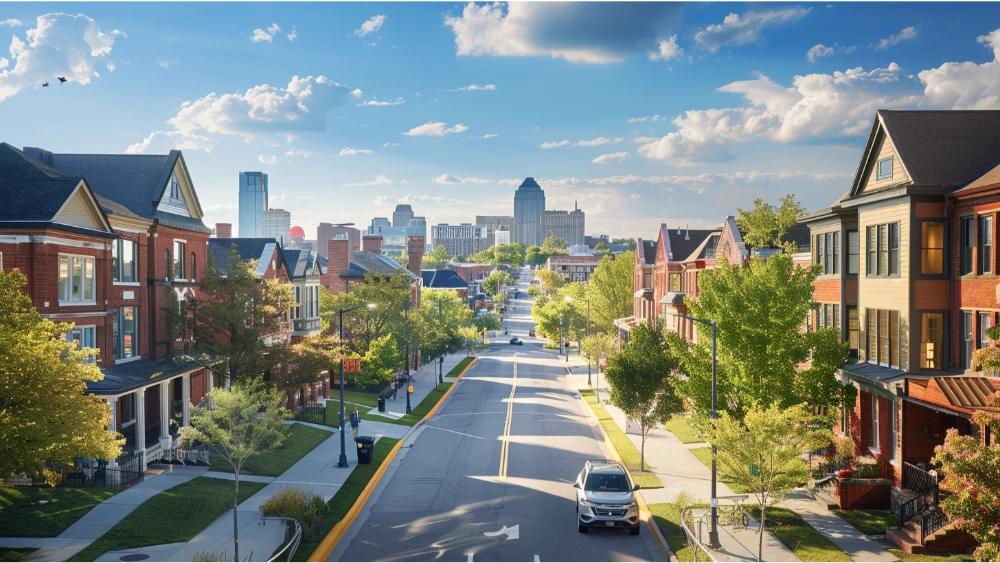
The city holds more than 240 distinct neighborhoods. Compare them by housing form, commute, walkability, parking and transit access.
Streetcar-connected: Downtown, River Market, Crossroads Arts District
Apartments and converted commercial buildings dominate, with the fare-free streetcar running through all three and into the city center. River Market centers on the historic City Market and riverfront. The Crossroads is the gallery and nightlife hub, walkable to downtown offices. These are the easiest neighborhoods to live in without a car. Expect to pay for parking.
Historic neighborhoods: Midtown, Westport, Country Club Plaza, Brookside, Waldo
Historic homes, much of the stock early twentieth century, paired with neighborhood commercial strips. The Plaza is the shopping and dining hub with apartments and condominiums alongside it. Brookside and Waldo lean toward houses with yards and local businesses you can walk to, with schools and parks close by.
Lower-density: North Kansas City, the Northland and South Kansas City
North of the river you get newer, lower-density neighborhoods, retail centers and quick airport access. South Kansas City, including Red Bridge and Martin City, mixes housing forms and school districts. Both are car-dependent, and both run generally lower on cost per square foot than the streetcar corridor.
For any listing: map the drive at your actual departure time, check transit within walking distance, confirm parking, and verify the assigned schools by exact address.
Kansas City Missouri Schools: Finding Great School Districts by Address
Fifteen public school districts serve parts of Kansas City, Missouri, and their boundaries cut across neighborhoods rather than following them. A Kansas City mailing address does not mean a home is assigned to Kansas City Public Schools, formerly the Kansas City Missouri School District.
Families hunting for excellent schools should verify in three steps. Enter the exact address into the official district finder. Review performance data through Missouri DESE, which advises confirming boundaries with county authorities. Then call the district about enrollment, transfers, charter options and transportation. Within KCPS, neighborhood schools serve students inside the relevant boundaries, while signature schools require an application; for 2026-27, KCPS listed a November application opening with a February lottery deadline. Search by address, not by school name.
Higher education sits inside the city too, including UMKC, the Kansas City Art Institute and Rockhurst University.
Health Care and Hospitals in Kansas City

Major facilities include University Health Truman Medical Center, Saint Luke’s Hospital of Kansas City, Research Medical Center, Children’s Mercy Hospital, University Health Lakewood Medical Center, Saint Luke’s North and St. Joseph Medical Center. Adult and pediatric Level I trauma care are both available in the city, though state designation lists are updated periodically.
If anyone in your household has ongoing care needs, map the drive from each prospective rental to that facility and to an in-network urgent care before you sign.
Getting Around: Do You Need a Car?
Most residents drive. The mean commute is 21.7 minutes (Census, 2020-2024), short for a city this size. The realistic car-light option is the streetcar corridor.
Correct one outdated claim you’ll see repeated: not all transit here is free. RideKC bus fares returned June 1, 2026 at $2 per single ride, $4 for a day pass and $62.50 monthly. The KC Streetcar remains fare-free, running 6.5 miles across 32 platform stops linking the riverfront, downtown, Midtown, the Plaza area and UMKC. Kansas City International advertises more than 50 nonstop routes. Budget for paid parking downtown.
Kansas City Weather: Four Distinct Seasons
| Month | Avg. high | Avg. low |
|---|---|---|
| January | 38.6°F | 21.2°F |
| July | 87.3°F | 67.4°F |
Summers get hot and humid with regular stretches in the 90s. May is the wettest month at 4.68 inches of normal precipitation. Winter brings freezing temperatures and periodic snow or ice.
Seasonal changes drive real costs and shape daily life here, so ask any landlord three questions before signing: who maintains the HVAC, whether there’s basement or shelter access for spring storms, and who handles snow removal and frozen pipes. At KT Rents, maintenance requests come through the owner and resident portal so nobody is guessing who to call at 2 a.m.
Things to Do: Arts, Green Space, Food and Professional Sports
Kansas City Missouri Parks and Recreation runs 222 parks, more than 12,000 acres, 158 miles of trails and bikeways, 29 lakes, 115 playgrounds and 48 fountains. Loose Park, Swope Park and the Trolley Track Trail anchor the green space in their own neighborhoods, with walking paths and enough outdoor activities to fill a weekend.
The arts and food side runs deep. The National WWI Museum and Memorial, the Nelson-Atkins Museum of Art, the Negro Leagues Baseball Museum and the surrounding 18th & Vine jazz district, Union Station and the Kansas City Zoo & Aquarium cover most weekends. The Kauffman Center for the Performing Arts handles symphony, ballet and opera. First Fridays turn the Crossroads into a monthly street event. Barbecue and live music are the city’s two exports, and together they give the place a strong cultural identity you pick up in week one.
Pro football, the Kansas City Royals, Sporting Kansas City and a women’s professional soccer club all play here. Plenty of it, from the streetcar to the City Market, costs nothing.
Is Kansas City Safe? How to Research an Address
Violent crime rates run above the national average, and the city has recorded historically high homicide counts in recent years. The police department publishes a crime-mapping tool and states that it makes no judgment about the relative safety of any neighborhood. Research the block, not the label:
- Review several months on the KCPD map, not one incident.
- Walk the block and your commute route at different times of day.
- Check street and parking-area lighting after dark.
- Inspect building access points and maintenance condition.
- Ask the property manager about access controls and repair turnaround.
Your First 30 Days in a New City
- Document move-in condition with dated photos before you unpack.
- Request KC Water service and set up power.
- Confirm trash eligibility and pickup day. The city provides weekly trash and unlimited recycling for single-family homes and buildings of six units or fewer.
- Title your vehicle in Missouri within 30 days of establishing residency.
- Transfer your license. An out-of-state license, or one expired by no more than 184 days, may generally be surrendered to waive testing. REAL ID generally requires two documents proving Missouri residency.
- Verify 1% earnings-tax withholding with your employer.
- Enroll students using the exact address, not the ZIP code.
- Locate the nearest urgent care and emergency room.
Pros and Cons of Living in Kansas City
Pros:
- Housing (82.9) and transportation (80.1) well below the national average, metro, Q2 2026
- 21.7-minute mean commute
- 222 parks, 158 miles of trails, and a dense arts and museum scene
- A diverse employment base across several large sectors
Cons:
- Car dependence outside the 6.5-mile streetcar corridor
- Violent crime rates above the national average
- Utilities (98.1) and groceries (96.7) near the national average
- A bi-state metro, 15 school districts and 240-plus neighborhoods add research work
Frequently Asked Questions
Is Kansas City a good place to live?
For many households, yes. The metro index was 86.6 against a U.S. baseline of 100 in Q2 2026, and parks, schools and cultural access are easy to reach. No city is a perfect place for everyone, and conditions vary block to block, so research the specific address.
What are the best neighborhoods?
It depends on your commute and housing form. The streetcar neighborhoods suit people who want to live car-light, the historic belt suits those who want sidewalks and older houses, and the Northland suits renters chasing newer construction.
What salary is needed to live comfortably?
Use the 30%-of-gross-income guideline. Against the September 2026 average asking rent of $1,420, that points to roughly $56,800 gross. Against the Census median gross rent of $1,238, closer to $49,500. Median household income in the city was $69,166 (2020-2024).
Is Kansas City growing or declining?
Growing. The Census estimated 521,220 residents as of July 1, 2025, up 2.6% from the April 2020 estimate base, and its city profile carries median age and household size if you want the fuller picture.
Do you need a car?
Living in Kansas City without a car is realistic along the fare-free streetcar line through downtown, Midtown and the Plaza area. Elsewhere, plan on a car.
Find Your Kansas City Rental with KT Rents
Browse rental properties across Kansas City neighborhoods, pressure-test your budget with the Rent Calculator, Cost of Living Calculator and Rent vs. Buy Calculator, then submit an application. Find Your Perfect Home Near You.
Relocating but keeping a property, or buying one here? Our full-service, broker-owned management covers tenant placement, tenant screening, rent collection, property maintenance, rental permits, 1099s, property inspections and court evictions, with a reported 98% occupancy rate. As of early 2025 we managed 683 units across 34 states representing $187M. Call (800) 716-4950, text (608) 207-0657, or email info@ktrents.com. We respond within 24 hours. Your Rental. Your Way.