

Warwick, Rhode Island
Homes for rent and for sale — search the map or open the full city SEO catch-all page.
Warwick, Rhode Island
Moving to Warwick, Rhode Island means settling in a coastal city of 83,000 residents about 12 miles south of Providence, where the median single-family home sells for around $410,000 and average two-bedroom rent runs roughly $2,357. The city offers 39 miles of Narragansett Bay shoreline, strong highway and airport access, and a diversified economy. Your day-to-day experience depends heavily on which of the 30-plus villages you choose, so always evaluate schools, flood exposure, and commute by exact address.
Moving to Warwick, Rhode Island
Warwick is a coastal, suburban “city of villages” about 12 miles south of downtown Providence, offering more affordable housing than Providence or Boston, strong highway, airport, and rail access, and 39 miles of Narragansett Bay coastline. The trade-offs are real: a competitive housing market, a car that comes in handy in many villages, school assignments tied to your exact address, airport noise near some properties, and coastal flood exposure worth checking before you sign. This guide is for anyone moving to Warwick who wants to evaluate a real address, not just a vibe. Your day-to-day experience in Warwick RI depends heavily on the specific village and street you choose. We’re KT Rents, a nationwide, broker-owned, full-service property operator, and we help renters and owners evaluate rentals and relocation decisions across the U.S.
Warwick at a Glance: A City of Villages on Narragansett Bay
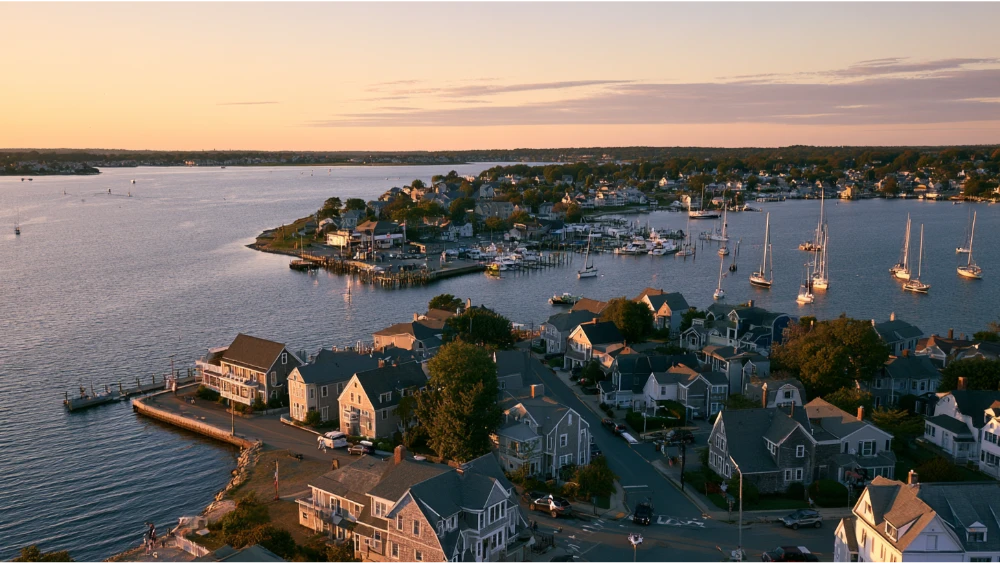
Rhode Island is small, and Warwick is its second-largest city with around 83,000 residents. Set in southern New England along the bay, Warwick sits in central Rhode Island and spans roughly 35 square miles, wrapping around the western shore of Narragansett Bay. That gives it 39 miles of coastline and the kind of four-season New England weather you’d expect, with easy coastal access from many villages. What catches most newcomers off guard is that Warwick isn’t one downtown-centered place. It’s a collection of more than 30 distinct villages, each with its own feel and suburban feel overall. Living in historic Pawtuxet Village is a different life from Cowesett, Oakland Beach, or the Route 2 retail corridor. Its rich history runs through nearly every one of those village centers.
- Population: ~83,000
- Area: ~35 square miles
- Villages: 30+
- Coastline: 39 miles on Narragansett Bay
- Distance to Providence: ~12 miles
Cost of Living in Warwick, RI: How Much Does It Cost?
Warwick costs more than the national average to live in, but it’s more affordable than Providence or Boston. Before you compare listings, understand one thing: the Census median gross rent of about $1,363 reflects existing occupied rentals, not what you’ll pay entering the market today. The 2024 data in Rhode Island’s 2025 Housing Fact Book puts the average two-bedroom rental payment closer to $2,357. That gap matters when you’re budgeting, and it shapes how much affordable housing you’ll actually find at a given address.
| Figure | Amount | Source/date |
|---|---|---|
| Census median gross rent | $1,363 | 2020–2024 ACS (existing rentals) |
| Average two-bedroom rent | $2,357 | 2024 data, 2025 Housing Fact Book |
| Median single-family sale price | $410,000 | 2024 data, 2025 Housing Fact Book |
| Median household income | $88,708 | 2020–2024 ACS |
| Cost-burdened renter households | 55% | 2025 Housing Fact Book |
Rhode Island also carries relatively high property taxes, and the statewide sales and use tax is 7%. The median home value in Warwick tracks close to that $410,000 median single-family sale price, so budget property taxes into any purchase before you commit. More than half of Warwick’s renter households are cost burdened, meaning they spend at least 30% of income on housing. Run your own numbers with our Rent Calculator and Cost of Living Calculator before you commit to an address.
Why Warwick Rent Numbers Don’t Match: Making Sense of the Housing Market
If you’ve browsed a few sites, you’ve seen wildly different “average rent” figures for Warwick. They’re not wrong, they just measure different things. Census gross rent is a five-year average of occupied units. A two-bedroom average captures one unit type. All-unit-type figures blend studios with four-bedrooms. About 74% of Warwick’s housing stock is single-family, and rental units skew smaller, with many one-bedrooms. So a single live listing is never the citywide average. Use the Housing Fact Book as a baseline, then compare current listings and the median home figures for the specific village you’re targeting.
Choosing an Area of Warwick: Neighborhoods, Nearby Cities, and Villages Compared
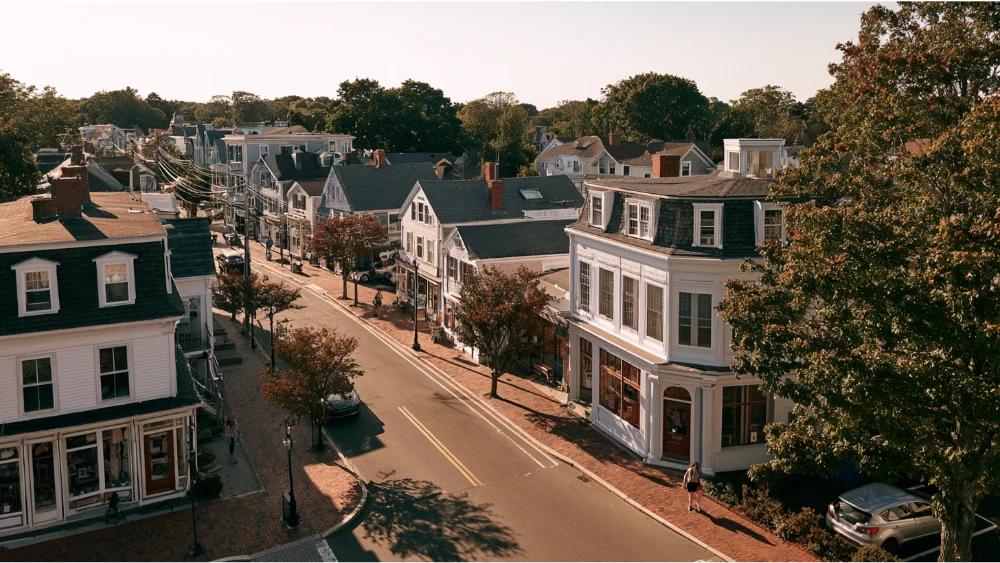
Character shifts block to block here, so compare villages by lifestyle and commute rather than chasing a “best” label. Nearby cities like Cranston, East Greenwich, and West Warwick each offer a slightly different balance of price, space, and commute, and they’re worth weighing against Warwick’s village choices.
- Pawtuxet Village: Historic Colonial and Federal architecture, local restaurants, antiques, and local boutiques tucked into the village streets.
- Apponaug: The historic civic center and home to City Hall, good for central access and historic character.
- Conimicut: A shoreline village with bakeries and neighborhood businesses near Conimicut Point Park. Coastal addresses warrant a flood-map check.
- Oakland Beach: Public beach, boardwalk, splash pad, playground, boat ramp, and marina access.
- Cowesett: Western Warwick shopping, dining, and entertainment.
- Pontiac / Route 2 corridor: Convenient shopping centers including Warwick Mall, grocery stores, and highway-oriented retail.
- Warwick Neck: Waterfront and historic attractions. Evaluate flood exposure and commute routes address by address.
Two homes a few streets apart can mean different schools, different flood zones, and a different commute. These relatively safe neighborhoods still vary street by street, which is why we always come back to the address.
An Address-First Due-Diligence Checklist for Any Warwick Property
Run this on any exact address before you apply:
- Which public school is assigned to it?
- Is it in a FEMA flood zone?
- Is it near an airport flight path?
- How far is it from I-95, I-295, or the RIPTA route you need?
- Is it on municipal sewer or an onsite system?
- Which water provider serves it?
- Which utilities are included in rent?
- How long is the commute during peak hours?
Renting vs. Buying in Warwick
About 73% of Warwick’s occupied units are owner-occupied and roughly 27% are rentals. With 74% of the stock single-family and a median single-family sale price near $410,000, buyers face a competitive market and real affordability pressure. That median home value, paired with Rhode Island property taxes, is the number to stress-test against your budget. Rentals skew to smaller unit counts, so space and bedroom availability can be tighter than you’d expect. If you need room to grow, factor that in early. Our Rent vs. Buy Calculator and Mortgage Calculator can help you frame the decision with your own numbers.
Getting Around Warwick: Highways, Train Service, and RI’s Main Airport

Given the 35-square-mile footprint and village-based layout, a car is useful in many parts of Warwick. Transit exists, but it follows corridors. I-95, I-295, Route 2, and Route 4 carry most local traffic, and downtown Providence sits about 12 miles up I-95. RIPTA buses serve major destinations including the airport, Kent Hospital, Warwick Mall, and CCRI’s Warwick campus. The InterLink station at T.F. Green offers MBTA commuter rail, and that train service puts Boston roughly 75 minutes away.
T.F. Green International Airport, often called Green Airport, is Rhode Island’s main airport and one of Warwick’s biggest relocation perks, with service from several airlines and connections to the intermodal station. That link to larger cities, from Boston to beyond, is a real draw for people living in Warwick RI who travel for work. The Census mean commute is 24.6 minutes, though it varies a lot by village and destination, and rush-hour congestion is real on I-95. If you’re eyeing an airport-adjacent address, visit at different times of day to judge flight-path noise for yourself.
Jobs and the Diverse Economy in Warwick
Warwick’s diverse economy is one reason the city holds steady through market swings. Health care anchors it through Kent Hospital, alongside retail, food service and hospitality, aviation and transportation (T.F. Green, UPS), administrative support, professional services, education, and local government. Insurance has deep roots here too, with Metropolitan Life Insurance among the largest employers that have operated in the area. As of 2025, Rhode Island’s labor data reported roughly 3,805 private-sector establishments in Warwick, about 44,376 average private-sector jobs, and an average private-sector wage near $63,866.
Just as important, the highway and transit access widens your practical job market. Many higher-paying positions sit in nearby Providence and the broader metro area, reachable by car or commuter rail. The Providence–Warwick metro unemployment rate was 4.2% in August 2026, a metro figure rather than a Warwick-only number.
Warwick Schools, School Quality, and Higher Education
We won’t hand you a blanket “good schools” or “bad schools” verdict, because school quality depends on your address and your family’s needs. Warwick Public Schools operates more than 25 schools, including two high schools, serving over 8,000 students, with a strong Career and Technical Education program and both public and private options in the mix. School assignment is tied to your exact address, so confirm placement directly with the district.
Rhode Island’s Department of Education publishes official report cards that rate schools one to five stars across achievement, growth, absenteeism, and graduation measures. Warwick is also building new Pilgrim and Toll Gate high school facilities, financed in part by a $139.58 million bond that closed in January 2026, with construction active through the year. For higher education, the city hosts CCRI’s Knight Campus, a community college option close to home, and a New England Institute of Technology campus. If school placement is a deciding factor, contact Warwick Public Schools before you sign a lease.
Hospitals and Health Care Near Warwick
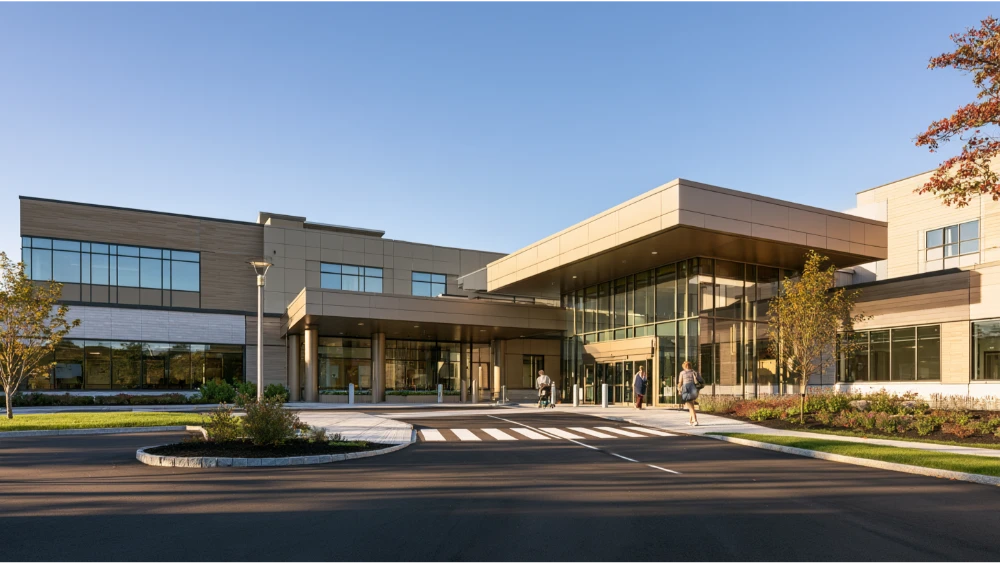
Kent Hospital is a 359-bed nonprofit acute-care hospital in Warwick, with a 24/7 emergency department that reports roughly 70,000 visits a year. Services span cardiology, oncology, orthopedics, OB/GYN, surgery, and rehabilitation. A major expansion and renovation is underway, so expect phased entrance, traffic, and parking changes through 2028. For specialty and teaching hospitals, Providence is a short drive north.
Food, Convenient Shopping, Coffee Shops, and Entertainment in Warwick
Warwick’s food scene runs from waterfront seafood to bakeries, coffee shops, diners, breweries, and international cooking spread across its village centers. The Route 2 corridor and Warwick Mall cover convenient shopping and larger-scale retail, while historic villages like Pawtuxet lean into small local businesses, antiques, and the kind of family-owned bookstore setting you don’t find in a strip mall. These urban amenities give Warwick plenty of options without the density of a big city. Add museums, movie theaters, historic sites, and regular community events, and you’ve got real variety rooted in the city’s long history.
Parks, Beaches, and Family Friendly Outdoor Life Along the Coast
This is where the Ocean State earns its name. Warwick offers a coastal location with 50-plus parks and playgrounds, 39 miles of coastline, nine fresh- and saltwater beaches, and 15 marinas or yacht clubs, much of it family friendly. The numerous parks and walking paths are one reason young families and retirees alike settle in.
- Goddard Memorial State Park: Nearly 490 acres with close to 20 miles of trails, a golf course, equestrian facilities with horseback riding, picnic areas, and beach access. Goddard Memorial State Park is one of the region’s standout green spaces.
- Warwick City Park: 126 acres with a three-mile paved walking and cycling path, dog parks, sports fields, and a saltwater beach.
- Rocky Point Park: Narragansett Bay views, shoreline trails, a fishing pier, and picnic areas.
- Conimicut Point Park: Shoreline walking, bay views, and easy beach access on the point.
- Oakland Beach: Swimming, picnicking, and that boardwalk-and-marina shoreline feel.
Between saltwater fishing, trails, and all that coastline, outdoor life is one of Warwick’s genuine draws, and the horseback riding at Goddard adds something you won’t find in most suburbs.
Lifestyle, Community Events, and Who Lives Here
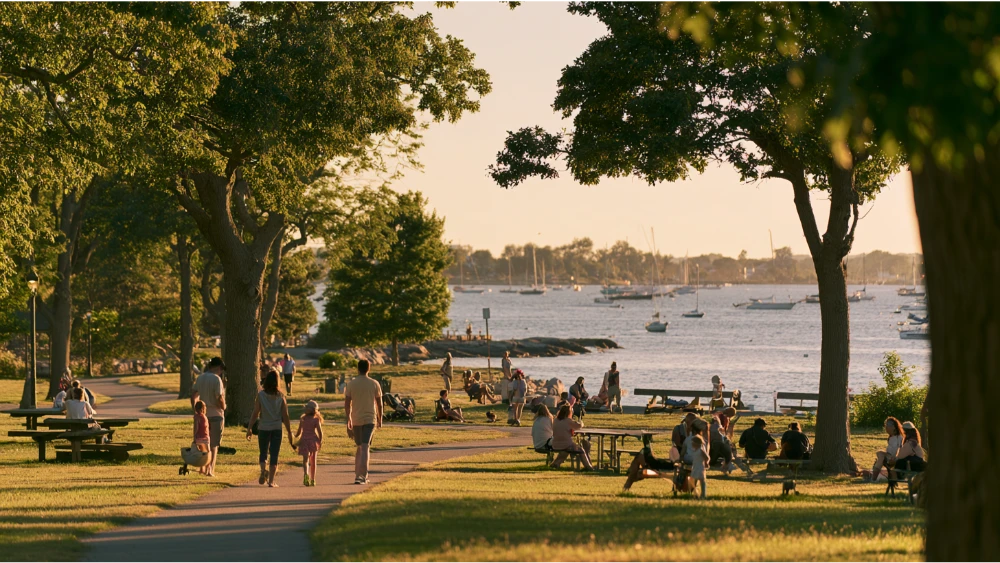
Most residents describe Warwick as a practical place to put down roots, with the median age landing in the low 40s and a steady mix of young families and longtime neighbors. As part of New England’s population centers near Providence, it blends small-village feel with real access. Regular community events, from summer concerts near the shore to seasonal festivals in the village squares, give newcomers an easy way in. It all makes Warwick feel lived-in rather than passed-through, and the mix of coast, parks, and services is what makes Warwick a great location for a wide range of households.
Weather, Flooding, and Coastal Storms in New England
You get four distinct seasons here, including cold New England winters. NOAA’s 1991–2020 normals show January averaging about 38°F high and 22°F low, July around 84°F and 65°F, roughly 36.6 inches of annual snow, and 47.54 inches of precipitation. Warwick’s coastal location means hurricanes can bring storm surge, coastal flooding, inland flooding, and wind damage to some areas. Don’t assume every waterfront property floods or that an inland one carries no risk. Check the exact address on the city’s GIS and FEMA flood maps, and talk to an insurance professional before you sign.
Utilities and City Services for New Residents
Trash is collected once a week, with carts out by 7 a.m. on collection day and bulky-item pickup by appointment, limited to three items. Recycling is mandatory and single-stream. Water comes from either the Warwick Water Division or the Kent County Water Authority depending on where the property sits. About 70% of developed parcels connect to municipal sewer, while the rest use onsite systems, and connection may be required within a year of gaining access. For questions on city services, Warwick City Hall and the mayor’s office under Mayor Frank Picozzi are the places to start. For a rental, confirm which utilities (water, sewer, trash, heat, electric) your rent actually covers.
Your Rhode Island Moving Checklist
This is general information, not legal advice, and rules change, so verify the current version before you move to this new city.
- Lease: Read it fully before signing.
- Security deposit: Capped at one month’s rent; landlords generally have 20 days after you move out and provide a forwarding address to return the balance with itemized deductions.
- DMV: Title and register an out-of-state vehicle within 30 days, complete a VIN check, and have the vehicle inspected within 5 days of registration.
- Insurance: Rhode Island liability coverage is mandatory.
- Utilities: Set up water, power, and anything not included in rent.
- Schools: Register children through Warwick Public Schools by your assigned address.
- Due diligence: Run the flood-map and airport-noise checks.
Remember the statewide sales tax is 7%, and factor property taxes into your housing math.
Pros and Cons of Living in Warwick RI
Pros: coastal lifestyle with 39 miles of shoreline and 50-plus parks, strong highway, airport, and rail access to larger cities and nearby cities across New England, more affordable than Providence or Boston, a diversified economy, and Kent Hospital close at hand. For many weighing RI quality of life, that balance is the draw.
Cons: an above-average cost of living, a competitive rental market with high renter cost burden, a car that’s useful in many villages, airport noise near some addresses, coastal flood exposure in parts of the city, and Rhode Island’s property taxes.
Frequently Asked Questions
Is Warwick, Rhode Island a good place to live?
It suits people who want a coastal, suburban lifestyle with easy access to Providence, an airport, and parks. Whether it works for you depends on the village and address you choose, so evaluate schools, commute, and flood exposure street by street.
How much does it cost to live in Warwick?
The cost of living runs above the national average, though it’s more affordable than Providence or Boston. Average two-bedroom rent was around $2,357 in 2024 data, and the median home sale price for single-family houses was near $410,000.
What is the downfall of living in Rhode Island?
The most common complaints are relatively high property taxes, a 7% sales tax, and above-average housing costs that leave many renters cost burdened.
Which areas of Warwick should I consider?
Compare villages like Pawtuxet, Apponaug, Conimicut, Oakland Beach, Cowesett, the Route 2 corridor, and Warwick Neck by commute and lifestyle, and weigh nearby East Greenwich too. Then check the exact address for school assignment and flood risk.
Is it cheaper to live in RI or MA?
It depends on the specific cities, but Warwick generally offers lower housing costs than comparable Boston-area options, which is a big reason commuters look here.
Make Your Move to Warwick Easier with KT Rents
We’re a nationwide, broker-owned, full-service operator. For owners, that means tenant placement, tenant screening, rent collection, and property inspections handled so you don’t lift a finger. For renters, moving to Warwick Rhode Island should feel like a welcoming experience that doesn’t end at the lease, with housewarming perks and real support when you need it. Start with our Rent Calculator, Cost of Living Calculator, and Rent vs. Buy Calculator, grab our free booklet of relocation tips, then browse confirmed available rentals and submit an application. Reach us at (800) 716-4950, text (608) 207-0657, or email info@ktrents.com. Your Rental. Your Way.