

Harrisburg, Pennsylvania
Homes for rent and for sale — search the map or open the full city SEO catch-all page.
Harrisburg, Pennsylvania
Moving to Harrisburg, Pennsylvania means settling into a compact state capital of about 50,522 residents where the Census median gross rent is $1,062 and current one-bedroom asking rents average $1,242. The metro unemployment rate sits at 3.7%, and the central location puts Philadelphia, Baltimore, and Washington within easy reach by car or Amtrak. Verify your exact address for school assignment, flood zone, local taxes, and parking rules before you sign anything.
Moving to Harrisburg, Pennsylvania
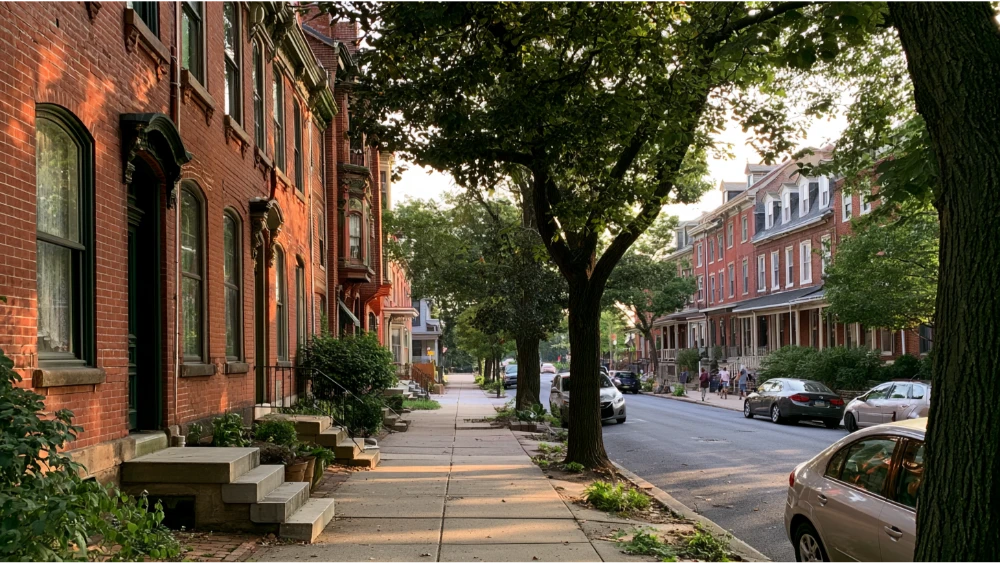
Harrisburg is a compact state capital where the Census Bureau reports a median gross rent of $1,062 (2020–2024) and an average one-way commute of about 20.1 minutes. Before you sign a lease, verify the exact municipality, school assignment, parking rules, flood zone, and local taxes, because all of those can change from one address to the next. The city itself holds roughly 50,522 residents (July 2025 estimate), so you’re moving to something walkable and human-scaled, not a sprawling metro.
This guide is for renters, remote workers, and families weighing Harrisburg against other cities. You’ll get real numbers instead of a vague “cost-of-living score,” practical help choosing a neighborhood, and a first-30-days checklist you can actually follow. We’re KT Rents, a broker-owned, full-service property management platform working nationwide since 2009. We don’t run a Harrisburg office, but we do know how to help people land somewhere that fits. Your Rental. Your Way.
Harrisburg at a Glance: The Numbers That Actually Matter
Here’s a dated snapshot. Every figure is labeled as city or metro and tied to a date, because third-party guides often blur the two or quote wildly different numbers (one source lists a metro-wide population near 186,000, another cites double-digit unemployment). We’re using Census and Bureau of Labor Statistics benchmarks so you’re working from the same ground truth we are.
| Metric | Figure | Scope and date |
|---|---|---|
| Population | ~50,522 | Harrisburg city, July 2025 estimate |
| Land area | 8.12 sq mi | Harrisburg city, 2020 geography |
| Median gross rent | $1,062 | Harrisburg city, 2020–2024 Census |
| Median home value (owner-occupied) | $124,200 | Harrisburg city, 2020–2024 |
| Owner-occupied rate | 36.6% | Harrisburg city, 2020–2024 |
| Median household income | $48,099 | Harrisburg city, 2020–2024 (2024 dollars) |
| Average commute | 20.1 min | Harrisburg city, 2020–2024 |
| Median age | varies by source | Harrisburg city, 2020–2024 |
| Unemployment rate | 3.7% | Harrisburg-Carlisle metro, Aug 2026 (preliminary) |
| Nonfarm jobs | ~368,100 | Harrisburg-Carlisle metro, Aug 2026 |
| Mean hourly wage | $30.61 | Metro, all occupations, May 2025 |
Treat these as starting points. The population is a city figure. The jobs and unemployment numbers cover the three-county metro. The median age sits in a range typical of urban areas rather than a retirement town, which shapes who you’ll meet on the block. Keep that distinction in mind as you read the rest, because it’s where most relocation guides go wrong. If you’re relocating from a bigger market, the headline takeaway is that affordable living here is backed by real numbers, not a marketing promise. The city offers a lower rent base than most comparable state capitals, and that affects every part of your budget once you arrive.
Harrisburg City vs. the Capital Region: Why Your Exact Address Rules Everything
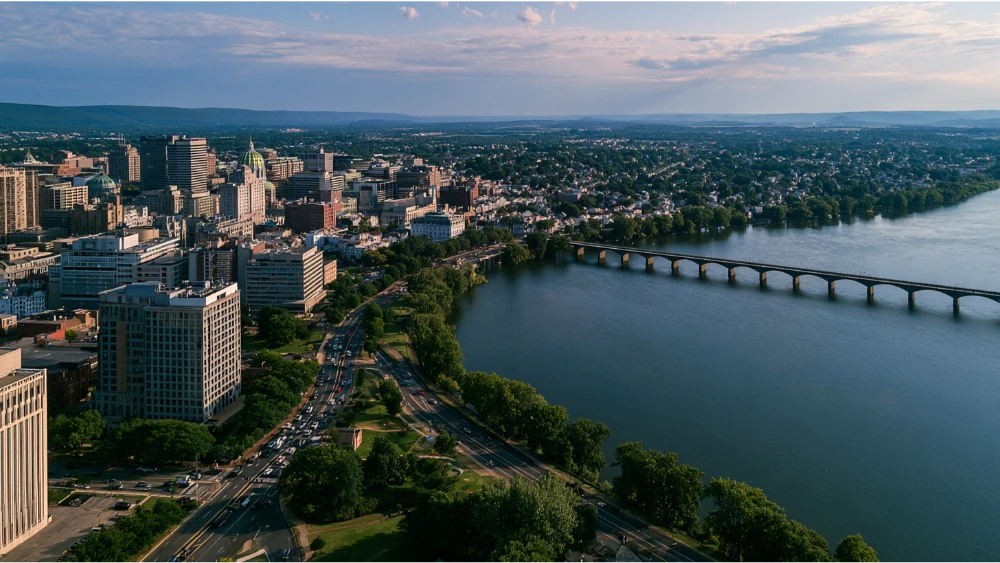
“Harrisburg” gets used loosely. People say it when they mean a suburb ten minutes away, a different school district, or a town with its own tax code. That matters more than it sounds. Your school assignment, local income tax, parking permit eligibility, and trash pickup all depend on the precise municipality your address sits in, not the name on your mail.
Harrisburg city is located on the east bank of the Susquehanna River. The broader labor market, the Harrisburg-Carlisle metro, covers Dauphin, Cumberland, and Perry counties. So when you read a job stat or a commute claim, check whether it describes the city of 50,522 or the metro of a few hundred thousand. For families comparing options across the region, this single distinction decides which schools your kids attend and how much you pay in local tax every year.
East Shore vs. West Shore
Locals split the region by which side of the river you’re on. The East Shore includes Harrisburg city itself and communities like the Central Dauphin area. The West Shore covers towns such as Camp Hill and Mechanicsburg, which are separate municipalities with their own districts and services. Crossing the river changes your commute, your tax jurisdiction, and often your rent. Movers relocating into the area often assume the whole region shares one set of rules, and that assumption can cost you.
Nearby towns and suburbs
Hershey is a frequent point of confusion. It’s a separate municipality, home to a major medical center and attractions, but it is not inside Harrisburg city. The same goes for Camp Hill, Mechanicsburg, and parts of Central Dauphin. These nearby towns are worth researching as regional options, just don’t assume they come with Harrisburg city rules. When you shortlist an address, confirm the municipality first. Everything downstream, from your earned income tax rate to who picks up your recycling, follows from that single detail.
What Does It Cost to Live in Harrisburg? Housing Costs and Affordable Living
Rather than hand you an affordability score, here are the actual numbers. The Census benchmark and current listing-market rents tell two slightly different stories, and both are useful. When people talk about affordable living in a state capital, the housing costs below are what they usually mean.
Rent benchmarks vs. current asking rents
The Census Bureau’s median gross rent for Harrisburg city is $1,062 for 2020–2024. That’s a multi-year benchmark, not today’s asking price. For a current read, a third-party rental tracker reported these Harrisburg apartment averages in October 2026:
| Unit type | Average asking rent (Oct 2026) |
|---|---|
| Studio | $964 |
| One bedroom | $1,242 |
| Two bedrooms | $1,464 |
| Three bedrooms | $1,867 |
| Rental house | $1,818 |
| Townhouse | $1,924 |
Asking rents move month to month and depend on where the platform draws its boundaries, so recheck them before you commit. With a city median household income of $48,099, those numbers put a one-bedroom in reach for many single earners, and the two- and three-bedroom tiers stay reasonable for families on a dual income, though your budget depends on your own income and debts. This is exactly why cost-of-living scores contradict each other. One guide calls Harrisburg slightly above the national average, another puts it roughly 10% below the national average. The methods differ. Real rent, income, and tax figures are harder to argue with. The honest summary: this lower cost of housing sits well under what you’d pay in the major cities a short drive away.
Utilities, insurance, and address-specific costs
Harrisburg runs four real seasons, which means both a heating bill in January and air conditioning in July. Older housing stock downtown and in the historic districts can swing those costs, so ask about insulation, window age, and past utility bills. Renter’s insurance is cheap and worth it. Flood coverage is a separate question tied to the exact address, which we’ll get to. Before you lock in a budget, run the math. Our Rent Calculator and Cost of Living Calculator let you test a specific rent against your income instead of guessing, which is the fastest way to see whether a given neighborhood actually fits the city living you want.
Choosing a Harrisburg Neighborhood: A Renter-First Comparison
We compare city neighborhoods by the things you can verify: housing type, walkability and transit, commute connections, parks and amenities, parking, and flood-zone status. We don’t rank areas by who lives there or slap “safe” labels on them, because that’s neither fair nor accurate. Verify school assignment and flood zone at your exact address before you decide. Picking the right neighborhood is the single biggest lifestyle choice you’ll make in this move.
| Area | Housing type | Walk/transit | Notes to verify |
|---|---|---|---|
| Downtown | Apartments, condos | High | Permit parking, event-day congestion |
| Midtown | Rowhomes, historic | High | Near Broad Street Market, street parking |
| Uptown/Riverside | Single-family, rowhomes | Moderate | River proximity, check flood zone |
| Shipoke | Historic rowhomes | Moderate | Riverside, flood lookup essential |
| Allison Hill | Mixed, rowhomes | Moderate | Varies block to block, visit in person |
| Bellevue Park | Single-family, historic | Lower | Quieter, more parking, car-oriented |
Downtown Harrisburg and Midtown
Downtown Harrisburg puts you near the Capitol, state offices, and the riverfront, with the most walkable footprint and the tightest parking. Its city center energy means restaurants, events, and government buildings all sit within a few blocks. Midtown is known for its historic charm and walkability, with the Broad Street Market and an arts district nearby. Both lean toward apartments and rowhomes, and both rely on street or permit parking. If you want a car-light lifestyle and easy access to restaurants and events on foot, this is where to look first.
Uptown/Riverside, Shipoke, Allison Hill, and Bellevue Park
Riverside and Shipoke sit close to the Susquehanna, which is a draw and a reason to check the flood viewer carefully. Both sit among the city’s historic districts, with older rowhomes that carry real character and the maintenance quirks that come with age. Allison Hill is large and varies noticeably from one block to the next, so judge it street by street rather than by reputation. Bellevue Park trends toward single-family historic homes and a quieter, more car-dependent setting that often appeals to families wanting more room and off-street parking. Harrisburg packs around 25 parks and playgrounds citywide, with landmarks like Italian Lake near Uptown, so green space is rarely far from any neighborhood you choose.
Italian Lake and the green-space advantage
Italian Lake deserves its own mention because it shapes the feel of the Uptown area. The landscaped ponds, bridges, and gardens give nearby residents a quiet escape without leaving the city, and it’s one of the reasons people who live in that part of Harrisburg talk about it the way they do. Green space like this is a genuine part of the local lifestyle, not an afterthought, and it’s worth walking before you settle on a block.
How to vet a block before you sign
Drive or walk the block at different times, morning, evening, and a weekend night. Check street lighting and where you’d actually park. Ask the property manager about building access, who handles maintenance, and how fast repairs happen. A good manager answers those questions without flinching. This is the kind of legwork that separates a rental you tolerate from one you’re genuinely happy to live in, and it’s how you spot the safe neighborhoods that fit your routine.
The Harrisburg Job Market and Career Outlook
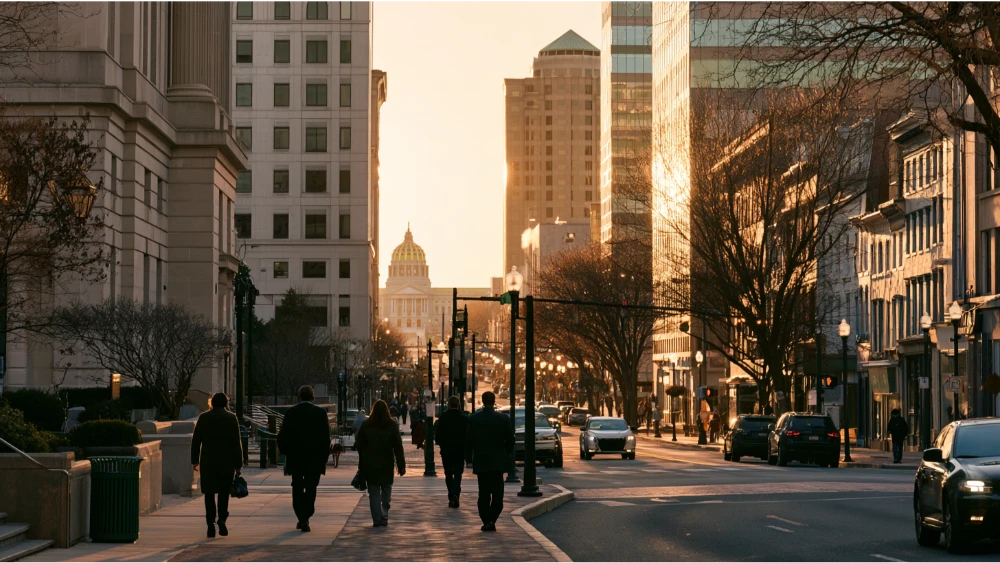
As the state capital, the local economy leans on government, and that gives the job market a steadiness you don’t always find in mid-sized metros. The Harrisburg-Carlisle metro reported a 3.7% unemployment rate in August 2026 (preliminary) across roughly 368,100 nonfarm jobs. You may see much higher figures floating around in other guides, sometimes above 10%. Those don’t match the dated BLS metro data, so we’ll stick with the official numbers.
The biggest employment sectors reflect the city’s role as a capital and a regional distribution and healthcare hub:
- State and local government
- Healthcare and education
- Trade, transportation, and logistics (warehousing is big in the region)
- Professional and business services
- Hospitality and leisure
On pay, the metro mean hourly wage across all occupations was $30.61 in May 2025, below the national average of $33.54. That gap is real, and it’s one reason lower rents matter here. For young professionals, the trade-off is a cheaper cost base against somewhat lower wages, and the stable job market softens the risk of a sudden layoff. Groups like Harrisburg Young Professionals give newcomers a ready-made network, which helps if you’re relocating without existing contacts. We’d steer you away from any “top employers” list that lumps Hershey or West Shore companies in as Harrisburg jobs, since the location shapes your commute and taxes.
Getting Around Harrisburg: Easy Access and an Ideal Location
Harrisburg’s central location in the Northeast is one of its real advantages. You’re within reasonable reach of several major cities, including Philadelphia, Baltimore, and Washington, which makes a weekend trip or an occasional office visit manageable without living in those cities’ price brackets. That easy access to the coast is a big part of why remote workers and commuters pick this market, and it’s a real argument for Harrisburg as an ideal location between larger hubs.
Driving and major interstates
The region is tied together by I-81 and I-83, plus I-283, US 322, and the Pennsylvania Turnpike. Driving is the default for most residents, especially off the downtown core. Rather than trust a blanket drive-time promise, test your exact route from a candidate address to your workplace during peak hours before you sign. The interstate network also gives you easy access to the surrounding towns when you need a bigger store or a different hospital, including a quick run toward York to the south.
Buses, Amtrak, and the airport
The Capital Area Transit bus system (CAT) serves Harrisburg and parts of Dauphin and Cumberland counties. Current fixed-route fares are $2 cash, $1.80 prepaid, and $55 for a 31-day adult pass, with transfers between fixed routes included for prepaid riders under current rules. Amtrak’s Keystone Service runs from Harrisburg east to Lancaster, Philadelphia, and New York, which is genuinely useful if your work or family pulls you toward the coast. Harrisburg International Airport currently advertises nonstop service to about 17 cities, with hub connections beyond that. Note the airport is located in Middletown, not inside the city.
Parking permits and street cleaning
Many residential areas use permit parking. To get a residential permit you generally need a current driver’s license and vehicle registration showing your address, or two other proofs of residency like a lease or utility bill if those don’t. Street cleaning runs twice monthly year-round, and enforcement applies on posted cleaning days, so learn your block’s schedule fast or you’ll meet it the hard way.
So do you need a car? In the walkable downtown and Midtown core, you can live without one if your job and errands line up with transit. Elsewhere, plan on driving. Don’t take “transit-friendly” at face value; bus usefulness depends on your route, the day, the service span, and transfers. Test the exact commute first.
Schools and Education in Harrisburg
The Harrisburg School District serves students within city limits, with six elementary schools among its buildings. For the 2026–2027 year, children entering kindergarten must be five years old by September 1. School assignment is address-based, so look up your specific address on the district’s boundary map rather than assuming by neighborhood. This is one of the first things families relocating with kids should confirm, ideally before they even tour a unit.
A notable freshness point: the district exited state receivership on June 17, 2025, becoming the first Pennsylvania district to do so. For performance, skip the commercial rankings and go straight to Pennsylvania’s official Future Ready PA Index, which reports academic achievement, growth, attendance, graduation, and college and career readiness at the school level. One score never tells the whole story, so read across those measures.
Beyond the city district, the region includes charter, private, virtual, and career-technical options, plus higher-education and training programs. Availability and admissions rules change, so confirm current details directly. Suburban districts on the West Shore and in Central Dauphin rank well regionally, but remember those are separate municipalities with their own taxes and commutes, which is exactly why families often weigh a slightly longer drive against a different school assignment.
Hospitals and Healthcare Access
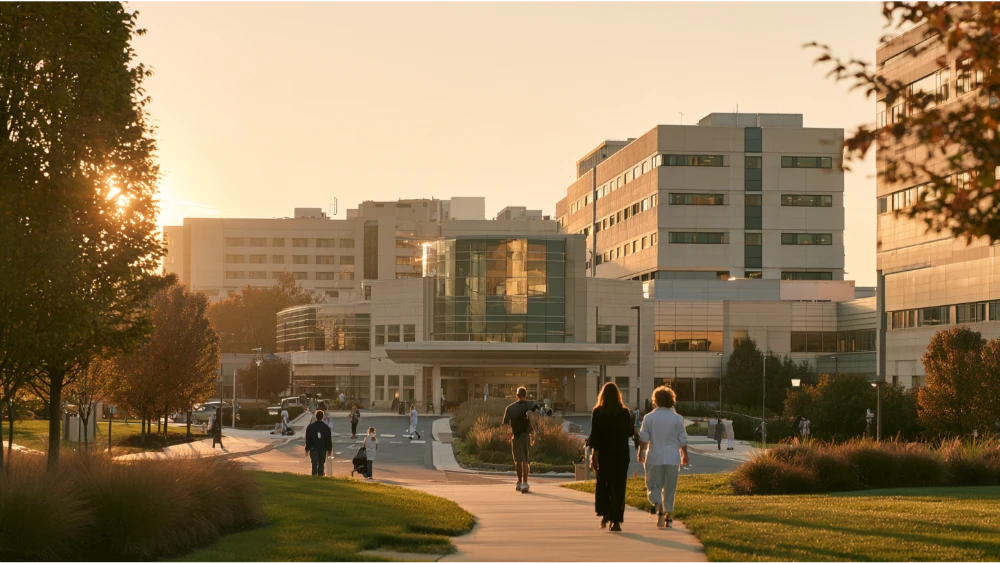
For care inside the city, UPMC Harrisburg is a 422-bed, full-service acute-care hospital downtown. Its emergency department runs 24/7 and is classified as a Comprehensive Stroke Center. That’s your closest major facility if you live in the core, and it’s one of the reasons downtown appeals to anyone who wants healthcare access within minutes.
For higher-acuity and pediatric trauma, the region leans on Penn State Health Milton S. Hershey Medical Center, with 631 licensed beds and the area’s Level I trauma center for both adults and children. Hershey is a separate municipality, not Harrisburg city, so factor the drive. Additional hospitals sit on both the East and West Shores, giving the broader harrisburg area and its healthcare systems solid coverage.
If you or a family member has recurring medical needs, compare more than distance to the nearest ER. Check where your specialists practice, whether a hospital is in your insurance network, how you’d get there by transit if needed, and what parking looks like on a bad day. A hospital five minutes closer isn’t the better choice if your doctor and your plan point elsewhere.
Food, Parks, and Everyday Lifestyle in Harrisburg
Start with a freshness note that trips up a lot of guides: the Broad Street Market in Midtown is partly operating during restoration. The Stone Building and a temporary tent are open on their current schedules, while the Brick Building is scheduled to reopen in 2027. Hours vary by building and day, so check before you go. Anyone describing both permanent buildings as fully open is working from stale information. The market anchors the daily lifestyle of the neighborhood around it, so it’s worth a visit even mid-restoration.
Riverfront, parks, and the Greenbelt
Life here bends toward the Susquehanna River. Riverfront Park stretches along the water downtown with public access right at the edge of the city center, and City Island, just offshore, offers mini golf, biking, riverboat cruises, and minor-league baseball, all within walking distance of downtown. The Capital Area Greenbelt is a roughly 20-mile loop connecting major parks and recreation areas with trails linking quieter spots like Reservoir Park and Italian Lake. With about 25 parks and playgrounds citywide, you’re rarely far from green space for outdoor activities, whether you want a morning run or a slow Sunday. For families, those parks double as the backbone of weekend plans without spending a dime, and easy access to this kind of recreation is a big part of what makes Harrisburg feel livable.
Food, markets, and seasonal events
Think of Harrisburg’s food scene as a set of experiences, not a list. Midtown gives you market vendors and prepared foods around the Broad Street Market. Downtown and the SoMa stretch serve dinner before or after a show, with bakeries, cafés, international spots, and food trucks filling in the gaps. The calendar carries its own weight: the Pennsylvania Farm Show draws big winter crowds, and the Kipona Festival turns the riverfront into a late-summer gathering. For culture, the Arts District holds 30-plus public murals, and State Capitol tours are free and genuinely worth an afternoon. It adds up to a city that feels lived-in rather than staged, and a lifestyle that rewards people who actually explore it.
Weather and Flood Risk: What to Check Before You Rent
Harrisburg runs a true four-season climate (NOAA uses 1991–2020 normals for comparisons): hot, humid summers, cold and snowy winters, and periodic heavy-rain events. Budget for both heating and cooling, and remember that an older or poorly sealed unit will cost more to keep comfortable.
Flood exposure is the part you cannot generalize. It’s address-specific, not neighborhood-wide, so never trust a blanket “that area floods” or “that area’s fine.” The city maintains a public flood-zone viewer covering the Susquehanna River, Paxton Creek, and the 100-year and 500-year floodplains. Look up your exact address there. Harrisburg also participates in FEMA’s Community Rating System, and under its current rating reports a 20% flood-insurance discount for qualifying properties in the 100-year floodplain and 10% in the 500-year floodplain.
Before renting anything near the river or with a basement, ask the owner or manager directly: Has there been prior water intrusion? What are the basement storage rules? Where’s the evacuation route, and who carries flood insurance on the building versus your belongings? Good answers here save you a very bad week later.
Taxes and Paperwork New Harrisburg Residents Should Know
These are some of the most practical numbers in this guide, because they answer real tasks, not vibes.
State and local taxes
- Pennsylvania personal income tax: a flat 3.07%.
- State sales tax: 6%. Unlike Philadelphia and Allegheny County, Harrisburg has no extra local sales tax listed by the state.
- Harrisburg resident earned income tax: currently 2% for 2026, split between the city and school district.
- Local Services Tax: $156 per year for covered workers in the city through 2030, subject to exemptions and payroll rules.
Local earned income tax is collected through Keystone Collections Group, and Pennsylvania assigns address-specific political subdivision (PSD) codes. The rate depends on your exact municipality and work location, so a “Harrisburg” mailing address outside city limits may owe something different. Property taxes also vary by municipality, which matters mostly if you’re buying.
Driver’s license, registration, and inspection deadlines
If you’re bringing a vehicle from another state, Pennsylvania runs a tight clock:
- Apply for PA title and vehicle registration within 20 days of establishing residency.
- Get your PA driver’s license within 60 days.
- Complete the required safety inspection within 10 days after registration.
- Pennsylvania insurance is required before you can title and register.
Put these on your calendar the week you arrive. The 20-day registration window sneaks up fast during a move, especially once the boxes and the movers have you distracted.
Your Stress Free Harrisburg Moving Checklist: First Week to First 30 Days
A stress free move comes down to sequencing, and a little planning keeps the whole thing hassle free. Here’s the order that works to save time once you arrive.
Before you sign:
- Confirm the exact municipality, school assignment, and flood zone for the address.
- Check parking permit rules and the street-cleaning schedule for the block.
- Run the rent against your budget with a rent calculator.
- Ask the manager about maintenance response times and building access.
Two weeks out:
- Book licensed movers for reliability and declutter before you pack to cut both cost and hassle. Reputable movers book up fast in peak season, so lock your date early.
- Label boxes by room and set aside an essentials box for the first night.
- Line up PA insurance so you can register your vehicle on arrival.
First week:
- Apply for your PA title and registration (20-day deadline).
- Set up utilities, renter’s insurance, and trash/recycling for your zone (city collects weekly by zone).
- Walk your neighborhood at a few different times to learn its rhythm.
First 30 days:
- Get your PA driver’s license (60-day deadline) and schedule your safety inspection (within 10 days of registration).
- Register for your residential parking permit.
- Confirm your local EIT setup via your employer and your PSD code.
Pros and Cons of Moving to Harrisburg, Pennsylvania
No city fits everyone, so here’s the honest ledger tied to the numbers above. This is a close look at the trade-offs of life in PA Harrisburg.
Pros:
- Rents run lower than larger cities, with a Census median gross rent of $1,062 and current one-bedroom asking rents around $1,242, which keeps affordable living realistic for both singles and families.
- Central location with easy access to major cities like Philadelphia, Baltimore, and Washington by car or Amtrak.
- A steady, government-anchored job market (3.7% metro unemployment, August 2026 preliminary).
- A compact, walkable core with real riverfront parks, historic districts, and an active arts and festival calendar.
Cons:
- Metro wages ($30.61/hr mean, May 2025) sit below the national average of $33.54.
- Flood exposure is address-specific and demands a real check, not a glance.
- School performance varies by building, so you have to verify by address.
- Third-party data is inconsistent, which makes careful, dated sourcing essential.
Find a Rental That Fits Your Move to Pennsylvania Harrisburg
When you’re ready to turn research into a home, the practical tools come first. Start with our Rent Calculator, Cost of Living Calculator, and Rent vs. Buy Calculator to pressure-test a specific address against your real budget. From there, browse our national rental marketplace to see what’s listed anywhere in Pennsylvania Harrisburg or beyond.
KT Rents is a broker-owned, full-service property management platform that’s been at this since 2009, 16-plus years of handling tenant placement, tenant screening, rent collection, property maintenance, and property inspections so residents get a genuinely seamless experience. We report a 98% occupancy rate as our stated claim, which tells you we treat occupancy quality as the whole point. State offices and the capital’s steady role play a major role in shaping this market, and we operate nationwide, not from a Harrisburg office, so check live inventory before assuming local availability. Ready to talk? Call (800) 716-4950, text (608) 207-0657, or email info@ktrents.com. Your Rental. Your Way.
Frequently Asked Questions
Is Harrisburg, PA a good place to move?
For many renters, yes. You get rents below larger cities (a Census median gross rent of $1,062), a central location with easy access to Philadelphia, Baltimore, and Washington, and a stable government-driven job market. Harrisburg offers a lot of lifestyle for the price, especially for families and remote workers. Just verify the address-level details, school assignment, taxes, parking, and flood zone, before you commit.
What is a good salary in Harrisburg, PA?
Use the city’s median household income of $48,099 (2020–2024) and the metro mean wage of $30.61 per hour (May 2025) as budgeting benchmarks. A single earner comfortably above those figures has solid footing against local rents, and a two-income household can afford a family-sized unit without strain. Test your own number against a specific rent with our Rent Calculator.
Is Harrisburg a red or blue city?
Harrisburg is Pennsylvania’s capital and the seat of state government. Political leanings shift by election and neighborhood, so we’ll keep this factual: it’s a capital city, and your experience there won’t hinge on a single label.
What areas should I research carefully in Harrisburg?
Research every neighborhood by the things you can verify rather than reputation: commute to your workplace, flood zone at the exact address, parking and street-cleaning rules, lighting, and building access. Visit the block at different times of day and ask the manager how maintenance is handled before you decide where you’ll live.
Can you live in Harrisburg without a car?
In the walkable downtown and Midtown core, it’s possible if your job and errands line up with CAT bus routes or walking distance. Outside that core, plan on driving. Either way, test your exact commute on the current trip planner before signing a lease.